

How UCAT Scoring Works: Scaled Scores, Percentiles & What Your Score Really Means
Everything you need to know about UCAT ANZ scoring — from raw marks to the 2700 Total Cognitive Score, separate SJT scoring, Score Reports and official percentile information.
- 12 min read
- Melbourne, VIC
- Tiffany Xu — UCAT Program Director
Quick Summary
How is the UCAT scored in Australia?
The UCAT ANZ is scored on the number of correct answers, with no negative marking. Raw marks for the three cognitive subtests — Verbal Reasoning, Decision Making and Quantitative Reasoning — are converted to a common scaled score range of 300–900. These three scores make up the 900–2700 total cognitive score. Situational Judgement is reported separately on a 300–900 scale. Pearson emails candidates within 24 hours with instructions to access their Score Report; UCAT ANZ publishes annual test statistics and makes its percentile-ranking information available after the test cycle.
Key Takeaways
- 1No negative marking — always guess. The UCAT ANZ awards marks only for correct answers. An incorrect answer scores zero, the same as leaving a question blank, so never leave a question unanswered.
- 2Raw marks are not comparable across cognitive subtests. Verbal Reasoning, Decision Making and Quantitative Reasoning contain different numbers of questions, so raw marks are converted to a common 300–900 scale before they are added.
- 3Your scaled score is not your raw mark. The official scoring page does not publish a personal raw-mark-to-scaled-score conversion table, so practice raw marks cannot predict an exact live-test scaled score.
- 4Use official percentiles as context, not as a cut-off. UCAT ANZ publishes annual total-score statistics after the testing cycle, but universities decide independently how they use the results.
- 5SJT is scored separately and still matters. Situational Judgement sits outside the 2700 cognitive total and is reported on its own 300–900 scale.
The Fundamentals
UCAT Scoring Basics: No Negative Marking and a Common Scaled Range
Before diving into scaled scores and percentiles, there are two fundamental characteristics of the UCAT ANZ that every student must understand — and that directly shape how you should approach the test on exam day. UCAT ANZ also confirms that performance on one question does not influence which later questions are presented: the test is not adaptive.
1. The UCAT has no negative marking. The UCAT ANZ is marked solely on the number of correct answers you give. There is no negative marking for incorrect answers. An incorrect answer scores zero — exactly the same as leaving a question blank. This is one of the most important test characteristics you need to know, because it changes your strategy completely.
Strategic implication. Because an incorrect answer and an unanswered question both receive zero, select your best answer for every question in line with the on-screen instructions. Do not leave a question blank simply to avoid a penalty: UCAT ANZ has no negative marking.
2. Why UCAT ANZ uses a common 300–900 scale. The current UCAT ANZ has three cognitive subtests with different question counts: Verbal Reasoning has 44 questions, Decision Making has 35, and Quantitative Reasoning has 36. A raw mark cannot therefore be compared directly between these subtests.
UCAT ANZ converts the raw marks from each cognitive subtest to scaled scores that share a common 300–900 range. The three scaled scores can then be added to form the total cognitive score from 900 to 2700.
Use the official UCAT ANZ practice materials to build familiarity with the current format. Do not rely on recalled questions or unverified claims about test versions, because they are not a substitute for official preparation resources.
How Scaling Works
From Raw Marks to Scaled Scores: How the 300–900 System Works
Once you complete the UCAT, your raw marks for each cognitive subtest are converted to a scaled score between 300 and 900. UCAT ANZ uses this common range because Verbal Reasoning, Decision Making and Quantitative Reasoning contain different numbers of questions, so their raw marks cannot be compared directly.
The official scoring page does not publish a raw-mark-to-scaled-score conversion table for individual candidates. Do not assume that a particular number of correct practice questions guarantees a particular live-test scaled score; use practice performance to identify skills to improve rather than to calculate an exact final score.
Raw mark → scaled score
UCAT ANZ explains the purpose of scaling — a common score range for cognitive subtests with different question counts — but does not publish a candidate-level raw-to-scaled conversion method or table on its official scoring page. The reliable information for candidates is the reported scaled score and the official annual test statistics.
| Subtest | Questions | Time | Scaled score | In the 2700? |
|---|---|---|---|---|
| Verbal Reasoning (VR) | 44 | 22 min | 300–900 | Yes |
| Decision Making (DM) | 35 | 37 min | 300–900 | Yes |
| Quantitative Reasoning (QR) | 36 | 26 min | 300–900 | Yes |
| Situational Judgement (SJT) | 69 | 26 min | 300–900 | Reported separately |
| Cognitive total (VR + DM + QR) | — | — | 900–2700 | — |
Official question marking. Verbal Reasoning and Quantitative Reasoning questions are worth one mark each. In Decision Making, single-answer questions are worth one mark; multiple-statement questions are worth two marks, with one mark for a partially correct response. SJT awards full marks for an exact match and partial marks for a close response.
Current-format reminder. The current UCAT ANZ has three cognitive subtests — Verbal Reasoning, Decision Making and Quantitative Reasoning — so the total cognitive score is out of 2700. Older resources may refer to a different format and a 3600 total. Always check the current official UCAT ANZ test format before comparing scores.
The 2700 Total
The Aggregate Score Out of 2700: How It All Adds Up
Once your three cognitive subtest scaled scores are calculated, they are simply added together to produce your aggregate cognitive total. This is the score out of 2700 that most people refer to when they talk about "UCAT scores".
For example, if you score 820 in Verbal Reasoning, 750 in Decision Making, and 800 in Quantitative Reasoning, your aggregate total is 820 + 750 + 800 = 2370 out of 2700. Situational Judgement is not included in this total — it is reported separately.
VR + DM + QR = cognitive total
Within 24 hours of completing the test, Pearson emails you instructions to access your UCAT ANZ Score Report. UCAT ANZ sends candidate results directly to consortium universities in early September. For 2026, preliminary test statistics are available in late August and the official Total Score percentile-ranking function is available in early September.
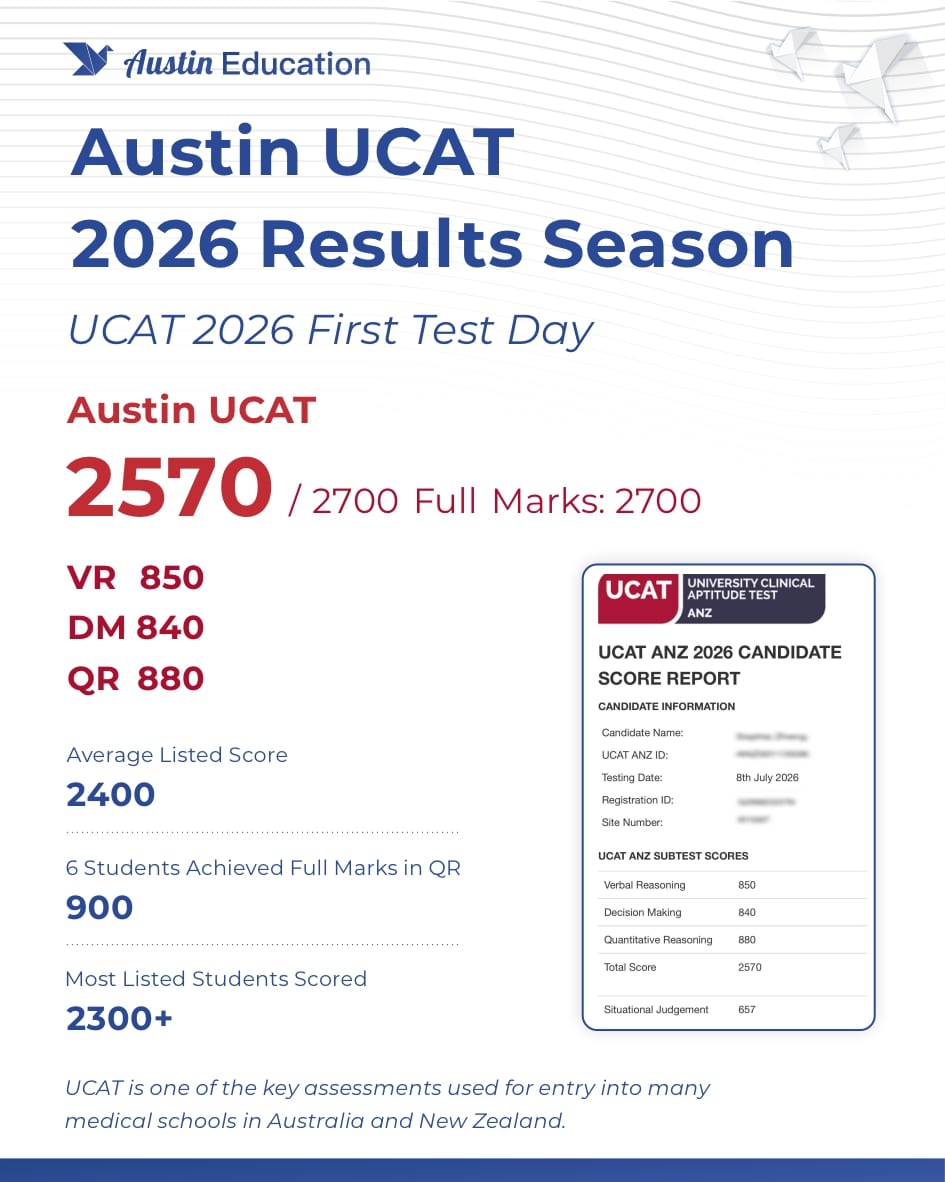
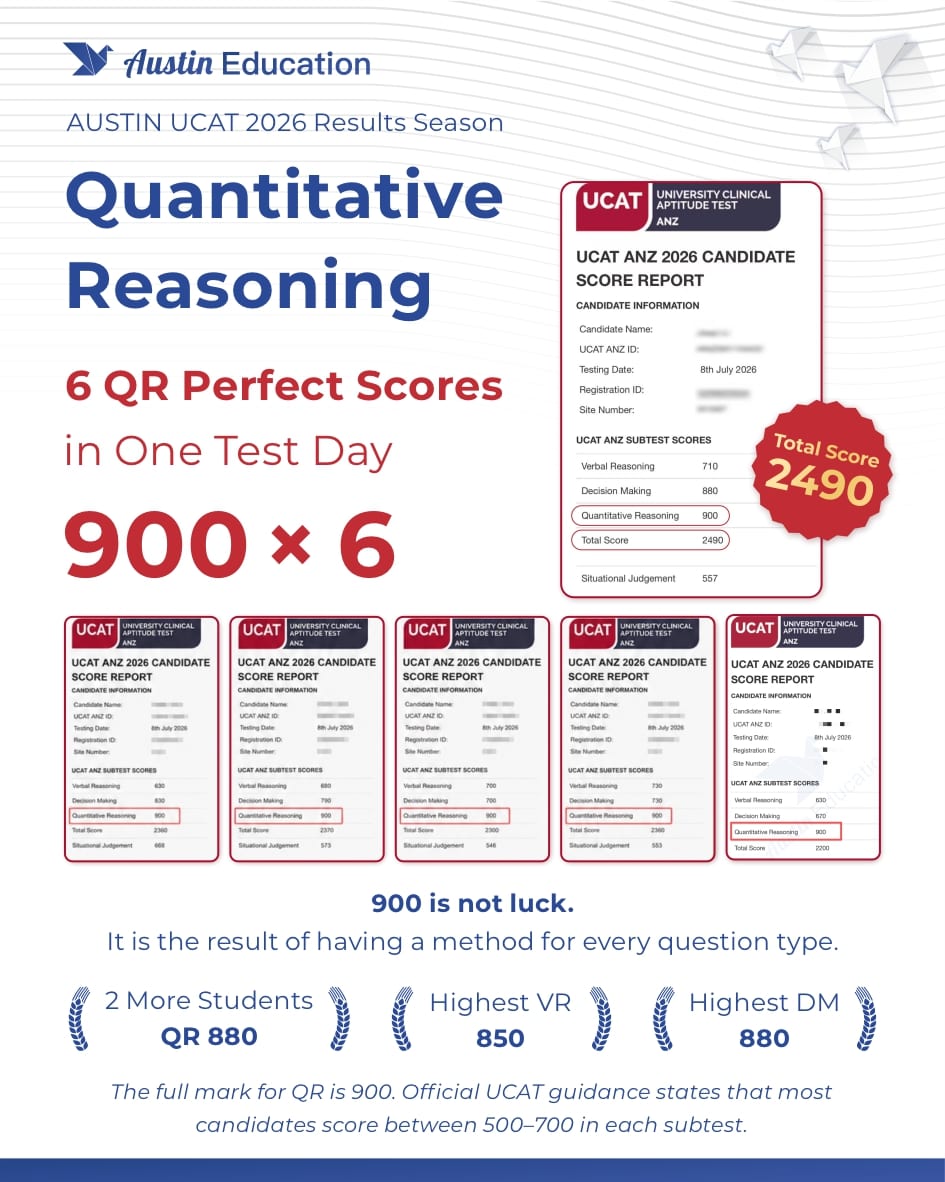
Austin Education result highlight. Austin Education reports a highest student UCAT Total Cognitive Score of 2570 out of 2700. This is an Austin internal programme result; the official 2025 UCAT ANZ summary table publishes decile points rather than a 99th-percentile total.
Understanding Percentiles
UCAT Percentiles Explained: What Your Ranking Really Means
A percentile places a Total Cognitive Score in the context of the cohort that sat UCAT ANZ in that testing cycle. For example, a 90th percentile means the score is at or above the level achieved by 90% of that cohort. UCAT ANZ publishes annual total-score statistics and makes its official percentile information available after the test cycle.
Percentiles are relative, not fixed. The same total score may correspond to a different percentile in another year. Use the official statistics for the relevant testing cycle as context; universities publish their own admissions rules and are not bound by a universal UCAT percentile threshold.
Source: official UCAT ANZ 2025 Summary Test Statistics (16,950 candidates, 1 July – 17 August 2025). The published table reports decile points; it does not supply 94th- or 99th-percentile totals.
What the official 2025 statistics show. For the 16,950 candidates included in the UCAT ANZ 2025 summary, the published median Total Cognitive Score was 1930 and the published 90th-percentile decile point was 2310. The difference is 380 scaled-score points across the three cognitive subtests.
That difference cannot be reliably translated into a fixed number of additional correct answers, because UCAT ANZ does not publish an individual raw-mark-to-scaled-score conversion table. Use the data to understand cohort context, then focus preparation on building reliable reasoning, interpretation and time-management skills.
“Official UCAT statistics provide useful context, but a score report should guide reflection rather than encourage false precision. The strongest preparation builds sound reasoning, accurate interpretation and disciplined timing.”
Situational Judgement
Situational Judgement: The Separate Score That Can Make or Break Your Application
Situational Judgement (SJT) is the fourth and final subtest of the UCAT ANZ. Unlike the three cognitive subtests, SJT is not included in the 2700 cognitive total. It is reported separately as a scaled score from 300 to 900.
For SJT, UCAT ANZ awards full marks when a response matches the correct answer and partial marks when it is close to the correct answer. The official scoring page does not report the current UCAT ANZ SJT result as Bands 1–4. SJT assesses the capacity to understand real-world situations and identify critical factors and appropriate behaviour in dealing with them.
How SJT marking works. SJT is not added to the 2700 cognitive total; it has its own 300–900 scaled score. UCAT ANZ states that exact matches to the correct answer receive full marks and responses close to the correct answer receive partial marks. Check each university's current admissions page to understand how, if at all, it considers SJT.
Score Benchmarks
What UCAT Score Do You Need for Medicine in Australia?
There is no single UCAT ANZ pass mark and UCAT ANZ does not set medicine admissions cut-offs. Consortium universities receive candidate results directly from UCAT ANZ in early September, but each university decides how it uses UCAT ANZ alongside its own academic, eligibility, interview and pathway requirements.
For this reason, do not treat a historical percentile or a number discussed online as a guaranteed threshold. Check the current admissions page for every university and pathway you plan to apply to. Requirements can differ materially between courses, applicant categories and admission cycles.
Official-source rule. UCAT ANZ supplies the test score. Universities publish their own admissions criteria. Always use the university's current official admissions information for decisions about course eligibility, selection processes and any score requirements.
Myths vs Facts
Common UCAT Scoring Myths — Debunked
Myth: "I should leave questions blank if I am unsure"
Because there is no negative marking, leaving a question blank is never the right choice. A blank answer scores zero — the same as a wrong answer. Always guess.
Myth: "My friend's answers from an earlier test date can help me"
Do not rely on recalled questions or unofficial descriptions of test versions. UCAT ANZ provides free official preparation resources and practice tests; these are the reliable way to understand the current format and practise relevant skills.
Myth: "A higher raw score always means a higher scaled score"
Not necessarily. UCAT ANZ reports scaled scores, not raw marks, and its official scoring page does not publish a personal raw-mark-to-scaled-score conversion table. Raw practice marks therefore cannot be used to calculate an exact final scaled score.
Myth: "SJT does not matter because it is not in the 2700"
Incorrect. SJT is not included in the 2700 cognitive total, but it is reported separately as a 300–900 scaled score. Check each university's current official admissions information to understand whether and how it considers SJT.
Improving Your Score
How to Improve Your UCAT Score: What the Scoring System Tells Us About Preparation
Understanding how UCAT scoring works has direct implications for how you should prepare. The scoring system reveals several important truths about what effective UCAT preparation looks like.
Attempt every single question — no exceptions
The no-negative-marking rule means your floor is zero regardless of whether you guess or leave blank. Always select an answer. If you are running out of time, use the last 30 seconds to click an answer for every remaining question.
Focus on speed, not just accuracy
The UCAT is designed to be extremely time-pressured. The biggest driver of score improvement is not getting harder questions right — it is answering more questions correctly within the time limit. Speed and accuracy must be developed together.
Build skills, not just question familiarity
Memorising recalled questions is not an effective preparation strategy. What transfers between official practice and the real test is cognitive skill — interpreting information, logical reasoning, numerical thinking and making sound decisions under time pressure.
Prepare for the percentile, not an absolute score
Use the official annual statistics to understand where a total score sits within a cohort, but do not set your preparation around an assumed universal cut-off. Focus on the skills and current university requirements relevant to your intended pathway.
Start preparation early — Year 10 or 11 is ideal
The cognitive skills tested in the UCAT — logical reasoning, verbal analysis, quantitative thinking — take months to develop. Students who begin structured preparation in Year 10 or 11 have a significant advantage over those who start in the weeks before the test, and the skills transfer to VCE and university study.

- ATAR 99.90 · UCAT 3200+ (pre-2025 format) · Current MD Candidate
- 100% of students reached the UCAT interview threshold
- Highest reported student UCAT score: 2570 / 2700
- Creator of Austin's UCAT Skill Development Framework
- Expert in long-term UCAT preparation and medical interview coaching
Frequently Asked Questions
UCAT Scoring FAQs
What is the UCAT scored out of?
The UCAT ANZ Total Cognitive Score ranges from 900 to 2700. It is the sum of three cognitive subtest scaled scores — Verbal Reasoning, Decision Making and Quantitative Reasoning — each on a 300–900 range. Situational Judgement is scored separately on a 300–900 range and is not included in the total. The current format has three cognitive subtests; older resources may refer to a different format and a 3600 total.
Is there negative marking in the UCAT?
No. There is no negative marking in the UCAT ANZ. Your score is based solely on the number of correct answers you give. An incorrect answer scores zero — the same as leaving a question blank. This means you should always attempt every question, even if you are unsure.
How are UCAT scores scaled?
UCAT ANZ converts raw marks to scaled scores because the three cognitive subtests have different numbers of questions. Each cognitive subtest is reported on a common 300–900 scale. The official scoring page does not publish an individual raw-mark-to-scaled-score conversion table, so raw practice marks cannot calculate an exact final scaled score.
What is a good UCAT score in Australia?
There is no universal good or pass score for UCAT ANZ. The official 2025 summary statistics show that a Total Cognitive Score of 2310 was the 90th-percentile decile point. Use this as cohort context, not as a universal medicine threshold: every university and pathway sets its own current admissions requirements.
When do you receive your UCAT score?
Within 24 hours of completing the test, Pearson emails you instructions to access your UCAT ANZ Score Report in your Pearson account. For 2026, UCAT ANZ states that preliminary test statistics are available in late August and the official Total Score percentile-ranking function is available in early September.
Why are UCAT raw marks converted to scaled scores?
The three cognitive subtests have different numbers of questions, so their raw marks cannot be directly compared. UCAT ANZ converts each cognitive raw mark to a score on the common 300–900 range; the three scaled scores can then be added to make the 900–2700 Total Cognitive Score.
What UCAT score do I need for medicine?
UCAT ANZ does not set medicine admissions thresholds. Check the current official admissions page for every university and pathway you are considering, because each institution decides how it uses UCAT ANZ alongside its other selection criteria.
How is the UCAT percentile calculated?
A percentile gives context for a Total Cognitive Score within the cohort that sat UCAT ANZ in the same testing cycle, and it can change from year to year. UCAT ANZ publishes annual statistics and, for 2026, states that its official Total Score percentile-ranking function is available in early September.
Ready to Build the Skills for a Competitive UCAT Score?
Book a free consultation with Austin Education's UCAT specialists, or watch our free UCAT & Medicine webinar to see how the program works.
Book a Free Consultation →- ✓100% Interview Threshold Rate
- ✓Highest Reported Score: 2570 / 2700
- ✓Free Trial Available
Continue Reading
Related Articles
- What is the UCAT? Complete Guide for Australian Students — subtests, timing and the medicine pathway.
- Austin's UCAT Program — structured, skills-based preparation with full simulation mocks.
- Free UCAT & Medicine Webinar — what medical schools are really looking for.
Austin Education is a Melbourne-based UCAT preparation provider. UCAT ANZ has a 900–2700 Total Cognitive Score formed by the scaled scores for Verbal Reasoning, Decision Making and Quantitative Reasoning, each on a 300–900 range, with no negative marking. Situational Judgement is reported separately on a 300–900 scale. Pearson emails candidates within 24 hours with instructions to access their Score Report; UCAT ANZ sends results directly to consortium universities in early September. Official 2025 statistics show 2310 as the ninth-decile Total Cognitive Score point for 16,950 candidates. UCAT ANZ does not set university admissions cut-offs; candidates should consult every university's current official admissions information.
By Tiffany Xu — Austin Education UCAT Program Director
Published