

How Mark Xu Achieved an ATAR 99.95 and an Oxford Medicine Offer
A 99.95 ATAR, a top UCAT score, and offers from Monash and Oxford — built on years of discipline, structure, and consistency.
- 5 min read
- South Australia · SACE
- For Medicine & High-ATAR Applicants
Quick Summary
How did Mark Xu achieve an ATAR 99.95 and an Oxford Medicine offer?
For many students these achievements feel almost impossible — but for Austin Education student Mark Xu, they were the result of years of discipline, structure, and consistency rather than last-minute cramming. Graduating from South Australia's SACE system, Mark built his results on three pillars: a huge volume of past exam papers (dating back to 1996) focused on understanding patterns rather than memorising answers; time management treated as a measurable system; and teaching concepts to others to expose gaps. Critically, he started UCAT preparation early — dedicating every Saturday from Year 9 — instead of leaving it too late.
Mark's Results · SACE, South Australia
Mark's journey from South Australia to Oxford Medicine shows that elite results are rarely accidental — behind every high ATAR and UCAT score is usually a system repeated consistently for years.
So how did he do it?
 Click to view full size
The Foundation
Mark's Biggest Advantage Was Consistency
According to Mark, high scores are rarely built through last-minute cramming. Instead, they come from repeating the right habits over a long period of time.
One of his most important strategies was to complete a large number of past exam papers — including some dating all the way back to 1996. Rather than simply memorising answers, he focused on understanding the patterns beneath them:
- Common question patterns
- Examiner expectations
- Recurring mistakes and traps
- Time management under pressure
He also completed Austin Education mock exams, deliberately designed to challenge students with unfamiliar questions — sharpening his adaptability for the real thing.
Time Management
Time Management Was Treated Like a System
Mark approached studying with a clear structure. Instead of vague goals like "study Chemistry tonight," he set measurable targets:
Turn vague goals into measurable targets
"Finish one Methods paper before lunch." "Correct Biology mistakes before dinner." "Complete Chemistry revision within a set time." Concrete, time-bound targets reduced procrastination and kept his progress consistent throughout the year.
Organise and track with the right tools
Mark used productivity tools such as Obsidian and Notion to organise tasks, link his notes, and track progress — so nothing slipped through the cracks across a heavy SACE + UCAT workload.
The Method That Mattered Most
One Study Method Changed Everything — Teaching Others
One of Mark's most effective learning strategies was teaching concepts to friends. By explaining topics out loud, he could quickly identify gaps in his own understanding and strengthen long-term memory.
According to Mark, students aiming for top scores should not just revise passively — they should actively explain ideas, discuss questions, and think like examiners.
UCAT Strategy
Why He Started UCAT Preparation Early
For medicine applicants, balancing the UCAT with Year 11 and 12 subjects is one of the biggest challenges. Mark believes the single biggest mistake students make is starting UCAT too late.
From Year 9 onwards, he dedicated every Saturday entirely to UCAT preparation. Over time, this built:
- Faster decision-making
- Stronger pattern recognition
- Better exam stamina
- Higher accuracy under pressure
As the exam approached, he also tracked every practice result using spreadsheets — analysing weaknesses and monitoring improvement over time.
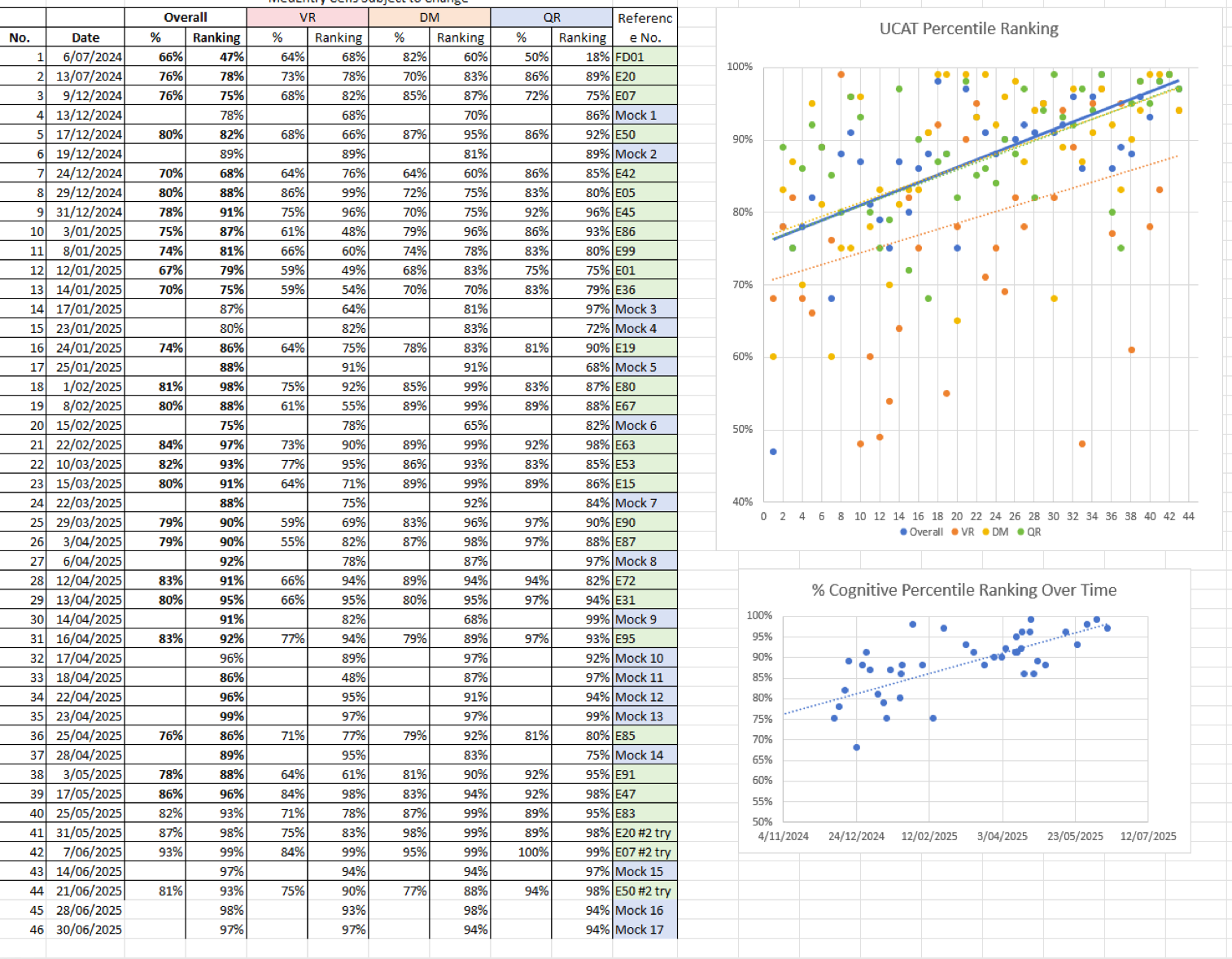 Click to view full size
The Takeaway
What Students Can Learn From Mark's Success
According to Mark, top-performing students are not always the smartest — they are usually the ones who follow a system, repeated consistently for years.
Key Takeaways
- 1Start earlier. Especially for the UCAT — beginning in Year 9 turned a high-pressure test into a long, steady build.
- 2Stay consistent. The right habits repeated over years beat any last-minute sprint.
- 3Analyse mistakes carefully. Past papers and trackers are about understanding patterns, not memorising answers.
- 4Follow structured systems. Measurable, time-bound targets plus tools like Obsidian and Notion keep heavy workloads under control.
- 5Teach to learn. Explaining concepts out loud exposes gaps and locks in long-term memory.
His journey from South Australia to Oxford Medicine shows that elite results are rarely accidental. Behind every high ATAR and UCAT score is usually a system that has been repeated consistently for years.
Watch the Full Video with Mark
In the full video, Mark shares the strategies that helped him achieve a 99.95 ATAR and secure an Oxford Medicine offer:
- How he balanced UCAT and school
- His exact study routines
- How he approached medicine applications
- Tips for high-ATAR students
- Advice for future medical applicants
Related Reading
Pair This Story With
- What is the UCAT? A complete Australia guide — the test structure, scoring, and what a competitive score looks like.
- UCAT planning & consultation — when to start and how to build a preparation timeline.
- ATAR & scaling explained — how raw subject scores become a final ATAR.
"Mark Xu, an Austin Education student from South Australia's SACE system, achieved an ATAR of 99.95, a UCAT score of 2520, and offers for Medicine from both Monash University and the University of Oxford — built on years of disciplined, systematic study rather than last-minute cramming."
"Mark's study system rested on three pillars: completing a large volume of past exam papers (back to 1996) to understand question patterns rather than memorise answers; treating time management as a measurable system using Obsidian and Notion; and teaching concepts to others to expose gaps in understanding."
"Mark believes the biggest mistake medicine applicants make is starting UCAT preparation too late. From Year 9 he dedicated every Saturday to the UCAT, building decision speed, pattern recognition, exam stamina, and accuracy, and tracking every practice result in spreadsheets to target weaknesses."
Frequently Asked Questions
FAQ: Mark's Path to Medicine
When should you start preparing for the UCAT?
Mark believes the biggest mistake students make is starting the UCAT too late. He began in Year 9, dedicating every Saturday to preparation. Starting early turns a high-pressure exam into a long, steady build — improving decision speed, pattern recognition, stamina, and accuracy over time rather than cramming in the final months.
How did Mark study for a 99.95 ATAR?
Mark relied on consistency rather than last-minute cramming. He completed a large volume of past exam papers (some dating back to 1996) to understand question patterns and examiner expectations, set measurable time-bound study targets, used Obsidian and Notion to organise and track progress, and taught concepts to friends to expose gaps in his understanding.
Why does completing old past papers help so much?
The goal is not to memorise answers but to understand the patterns beneath them — common question types, examiner expectations, recurring traps, and time management under pressure. Mark combined real past papers with Austin Education mock exams featuring unfamiliar questions, which improved his adaptability in the actual exam.
What does the 'teach others' study method involve?
It means actively explaining concepts out loud — to friends or even to yourself — rather than only revising passively. Teaching forces you to confront what you do not fully understand, quickly revealing gaps and strengthening long-term memory. Mark found it one of his single most effective strategies.
What ATAR and UCAT score do you need for medicine?
Medicine is highly competitive and requirements vary by university and pathway. Mark's ATAR of 99.95 and UCAT of 2520 are at the very top end. Because cut-offs and admissions models differ each year, the most reliable approach is to plan early with up-to-date, course-specific guidance rather than fixed numbers.
A Medicine Offer Starts With an Early, Structured Plan.
Mark's results came from starting the UCAT early and treating study as a system. Book a free consultation and we'll help you map a UCAT and ATAR plan built around your target course.
Book a Free Consultation →- ✓UCAT Specialists
- ✓Medicine Pathways
- ✓Melbourne & Adelaide
- ✓Real Student Results
By Austin Education UCAT Team
Published