

How Maya Shu Achieved a 99.8 ATAR and a Raw 50 in VCE English
Her success wasn't built on studying endlessly — it came from consistency, organisation, and highly effective study strategies.
- 6 min read
- Melbourne, VIC
- For VCE Year 11–12 Students & Parents
Quick Summary
How did Maya achieve a 99.8 ATAR and a raw 50 in English?
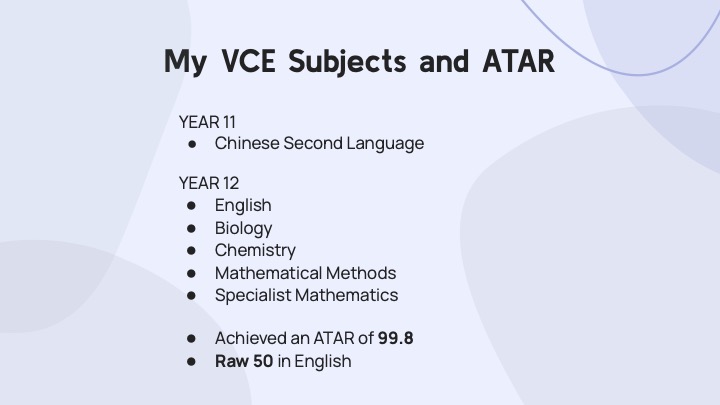
Maya did not simply study longer hours than everyone else — she studied smarter. She built a consistent, sustainable routine around four habits: rigorous organisation (using Notion and Google Calendar), distraction control, active revision methods such as the "1 Minute Method" and "Blurting," and a relentless focus on feedback. For English specifically, she prioritised meaningful practice writing, examiner feedback, and sophisticated topic sentences over rote-memorised essays. The result: a 99.8 ATAR while studying English, Biology, Chemistry, Mathematical Methods and Specialist Mathematics.
Maya's VCE Results
Raw
Achieved while studying a demanding load of English, Biology, Chemistry, Mathematical Methods and Specialist Mathematics — without burning out.
 Click to view full size
The Mindset
Maya's Secret Wasn't "Studying More" — It Was Studying Smarter
One of the biggest misconceptions about VCE is that top students simply study longer hours than everyone else. Maya approached VCE differently. Rather than chasing raw study time, she focused on a small set of habits that compounded over the year:
- Staying organised
- Reducing distractions
- Creating sustainable routines
- Using active study methods
- Improving through feedback
This allowed her to maintain consistency throughout the year without burning out. For many high-performing VCE students, how you study matters far more than how long.
Organisation
Organisation Was the Foundation of Maya's High Scores
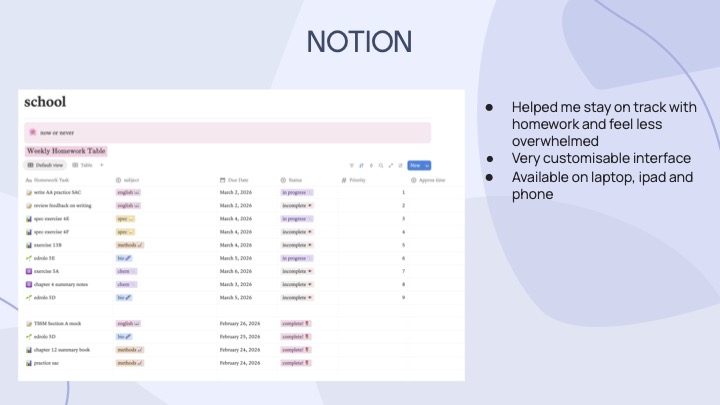
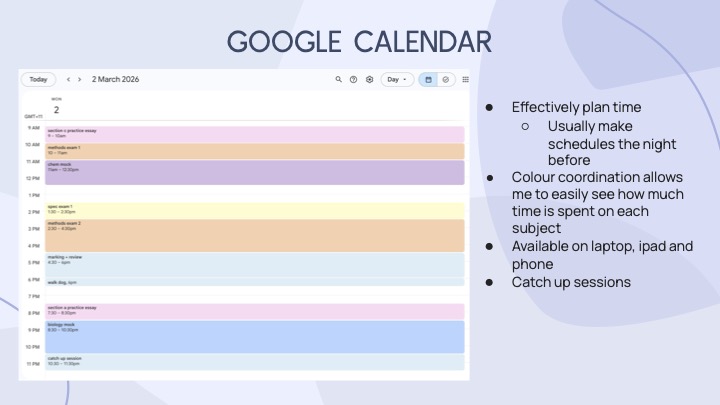
Maya explained that organisation played a major role in reducing stress during VCE. She used tools such as Notion and Google Calendar to stay on top of homework, revision and exam preparation, planning the next day's schedule the evening before and colour-coding each subject so she could see at a glance where her time was going.
Why this system worked
Tasks felt less overwhelming, study time became more structured, catch-up sessions could be planned early, and subject balance became far easier to manage. Colour-coding her calendar let her visually track how much time each subject was getting — and rebalance before any one subject slipped.
 Click to view full size
 Click to view full size
Study Techniques
The Study Techniques Maya Used During VCE
The "1 Minute Method"
Instead of forcing yourself to study for hours, tell yourself you only need to study for one minute. According to Maya, starting is the hardest part — once you begin, it becomes much easier to keep going. This is especially useful for procrastination, motivation slumps, and starting difficult subjects like Maths Methods or Chemistry.
Blurting for content-heavy subjects
For subjects like Biology, Maya used a revision technique called Blurting: learn the content, put the notes away, then explain everything you can remember out loud. This surfaces weak areas fast and strengthens long-term memory. Maya even did this casually on walks or at dinner — turning small moments into productive revision.
Focus
How Maya Avoided Distractions During VCE
Like many students, Maya recognised that phones can destroy concentration. To stay focused, she leaned on a few tools that made study sessions feel measurable and rewarding:
Time-lapse study recording
Recording her sessions kept her accountable and made long study blocks feel more rewarding.
Flora app
Locked distracting apps during focus sessions, turning concentration into a visible streak.
YPT study tracker
Tracked study hours per subject, making her effort measurable and easy to rebalance.
For VCE students, maintaining focus consistently across the whole year is often what separates strong scores from average results.
VCE English · Raw 50
How Maya Achieved a Raw 50 in VCE English
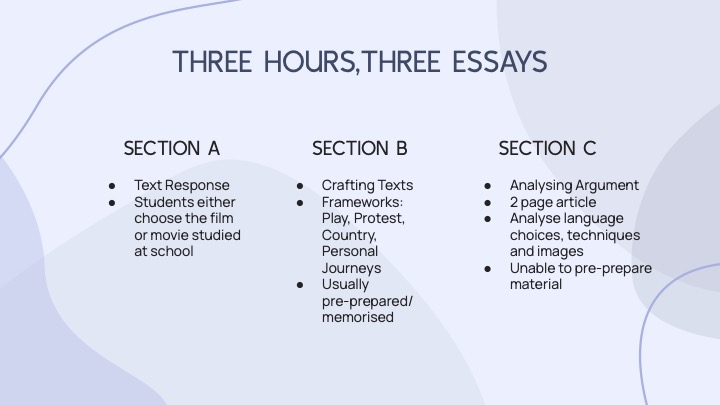
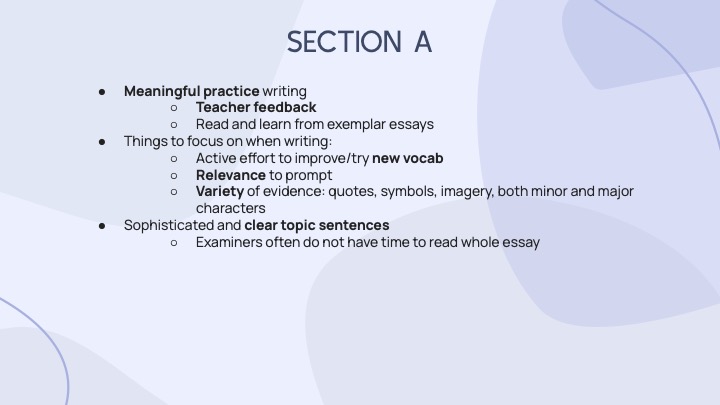
Achieving a raw 50 in English requires far more than memorising essays. Maya focused heavily on meaningful practice writing, acting on teacher feedback, reading exemplar essays, sharpening her topic sentences, and using varied evidence effectively.
"Examiners often do not have time to read every essay closely, so sophisticated and clear topic sentences matter enormously." — Maya's advice on what actually moves your English score
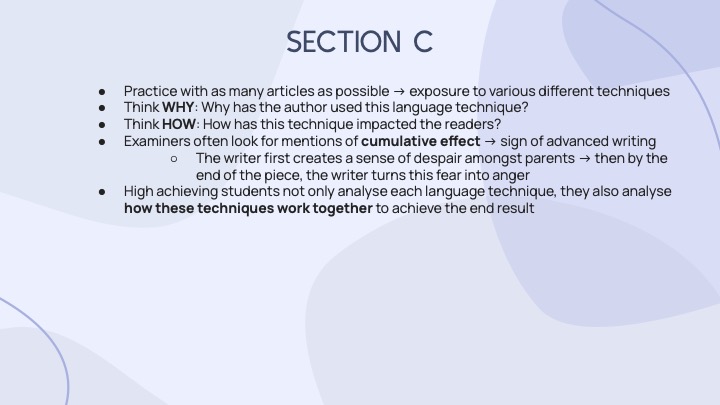
For Section C (Analysing Argument), Maya practised with as many articles as possible to expose herself to different persuasive techniques. Rather than only identifying language techniques, she pushed her analysis deeper by always asking:
- Why did the writer use this technique?
- How did it affect the reader?
- How did multiple techniques work together?
This deeper level of analysis is often what differentiates the highest-scoring English students from the rest.
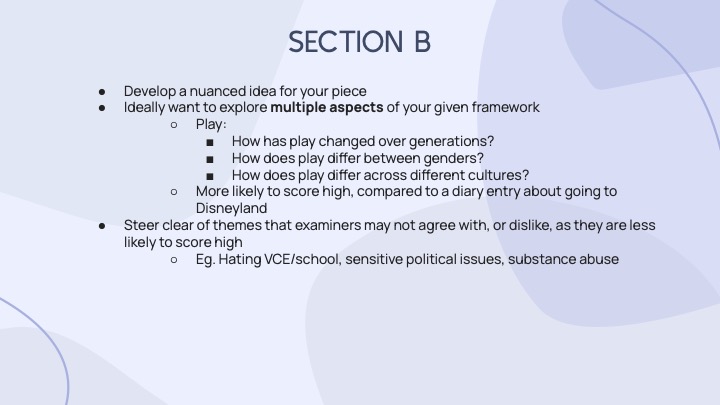
Her annotated breakdown of each section is shown in full below — tap any image to open it at full size.
 Click to view full size
 Click to view full size
 Click to view full size
 Click to view full size
The Takeaway
What VCE Students Can Learn From Maya
Maya's success was not based on shortcuts or "talent." Her results came from a repeatable system anyone can adopt:
Key Takeaways
- 1Consistency over intensity. A sustainable routine all year beats sporadic cramming.
- 2Structured study systems. Notion + a colour-coded calendar keep every subject in balance.
- 3Smart revision techniques. The 1 Minute Method beats procrastination; Blurting builds real recall.
- 4Continuous improvement. Act on feedback rather than just collecting it.
- 5Strong feedback loops. In English, sophisticated topic sentences and deep analysis move the needle most.
For many students, the biggest change is not studying harder — it is learning how to study effectively.
Watch Maya's Full VCE Study Tips Video
Want to see Maya explain her full study system, English strategies and productivity methods in detail? Watch the full Austin Education video to learn:
- How top scorers structure their week
- Effective VCE revision methods
- Raw 50 English advice
- Productivity systems for Year 11 and 12 students
- Common mistakes VCE students make
Related Reading
Pair This Story With
- VCE ATAR & scaling explained — how raw study scores become your final ATAR.
- The VCE English tutoring guide — how to lift Section A, B and C marks.
- When should you start VCE tutoring? — Year 10, 11 or 12, explained.
"Maya Shu, an Austin Education student, achieved a 99.8 ATAR and a raw 50 in VCE English while studying English, Biology, Chemistry, Mathematical Methods and Specialist Mathematics — built on consistency and effective study systems rather than long hours."
"Maya's core study system combined organisation tools (Notion and a colour-coded Google Calendar), distraction control (Flora, YPT, time-lapse recording), and active revision methods — the '1 Minute Method' to beat procrastination and 'Blurting' for content-heavy subjects like Biology."
"To score a raw 50 in VCE English, Maya prioritised meaningful practice writing, acting on teacher feedback, sophisticated topic sentences, and deep analysis in Section C — asking why a writer uses a technique, how it affects the reader, and how techniques work together — rather than memorising essays."
Frequently Asked Questions
FAQ: Maya's VCE Study Approach
How many hours a day did Maya study to get a 99.8 ATAR?
Maya's results were not built on extreme daily hours. She emphasised consistency and effective methods over sheer volume — a sustainable routine maintained across the whole year, supported by organisation tools and active revision techniques, rather than long cramming sessions or all-nighters.
What is the '1 Minute Method' Maya used?
The 1 Minute Method is a procrastination-beating technique: instead of committing to a long study block, you tell yourself you only need to study for one minute. Because starting is the hardest part, once you begin it becomes much easier to keep going. It is especially useful for difficult subjects like Maths Methods or Chemistry.
What is 'Blurting' and how does it help revision?
Blurting is an active-recall method: you learn the content, put your notes away, then explain everything you remember out loud. This quickly reveals weak areas and strengthens long-term memory. Maya found it effective for content-heavy subjects like Biology and even did it casually during walks or dinner.
How do you get a raw 50 in VCE English?
A raw 50 requires far more than memorising essays. Maya focused on meaningful practice writing, acting on teacher feedback, reading exemplar essays, writing sophisticated topic sentences, and using varied evidence. In Section C she analysed why writers use techniques, how they affect readers, and how techniques work together — not just identifying them.
Which tools did Maya use to stay organised and focused?
Maya used Notion and Google Calendar to plan and colour-code her subjects, and the Flora app, YPT study tracker, and time-lapse study recording to lock distractions and make her study time measurable and rewarding.
Your ATAR Goal Starts With a Better System.
Maya's results came from structure, smart revision, and strong feedback loops — exactly what Austin Education's VCE programmes are built around. Book a free consultation and map out your own path to a top ATAR.
Book a Free Consultation →- ✓VCE Specialists
- ✓Melbourne-Based
- ✓Year 11–12 Focus
- ✓Real Student Results
By Austin Education VCE Team
Published