

VCE Chemistry Strategy Guide:
How to Achieve a Study Score of 40+
A complete, expert-written guide for VCE Chemistry students — covering the 2024–2027 VCAA study design, Unit 3 & 4 content, SAC preparation, exam technique, and when to consider VCE Chemistry tuition in Melbourne.
- 15 min read
- Melbourne, VIC
- Austin Education Chemistry Team
Quick Summary
What is the best strategy for VCE Chemistry?
VCE Chemistry success requires three things: a thorough understanding of the 2024–2027 VCAA study design, consistent and structured revision across both Unit 3 and Unit 4, and disciplined exam technique. The final exam is worth 50% of your study score and covers all Unit 3 and Unit 4 content. Students who achieve study scores of 40+ combine deep conceptual understanding with regular practice on VCAA-style questions and targeted SAC preparation throughout the year. Familiarising yourself with new concepts like green chemistry principles and medicinal chemistry is essential for the updated study design.
Key Takeaways
- 1The exam is worth 50%: The final VCAA Chemistry exam is the single most important component of your study score. Students who underperform in SACs can recover significantly through a strong exam result — but only if they have built genuine conceptual understanding throughout the year.
- 2Unit 3 and Unit 4 are equally important: The SAC weighting (Unit 3: 20%, Unit 4: 30%) means Unit 4 SAC performance matters more — but the final exam covers both units equally. Neglecting either unit will cost you marks in November.
- 3Adapt to the 2024–2027 Study Design: Be prepared for the new focus areas, including sustainable chemistry (green chemistry principles), expanded medicinal chemistry, and the updated Data Book.
- 4VCAA exam reports are your most valuable resource: The VCAA publishes detailed examiner reports after every exam, identifying the most commonly misunderstood concepts and the most frequent mistakes. Students who read and act on these reports consistently outperform those who do not.
- 5Start tuition early — ideally at the beginning of Unit 3: VCE Chemistry builds on itself. Gaps in understanding from early in the year compound over time. Students who begin structured tuition at the start of Year 12 have the most opportunity to build the conceptual depth required for a study score of 40+.
Working through this guide on your own? Austin's VCE Chemistry tutoring adds weekly streamed classes, marked written homework and full-length mock exams — taught by VCAA examiners and textbook authors.
VCE Chemistry tutoringHow You're Assessed
Understanding the VCE Chemistry Assessment Structure
Before developing a study strategy, it is essential to understand exactly how your final VCE Chemistry study score is calculated. Unlike some VCE subjects where the exam carries a smaller weighting, Chemistry places significant weight on both your school-assessed coursework (SACs) and the final VCAA examination.
| Component | Weighting | Details |
|---|---|---|
| Unit 3 SAC | 20% | School-set assessment covering Energy Options and Optimising Chemical Processes |
| Unit 4 SAC | 30% | School-set assessment covering Organic Compounds Synthesis and Analysis |
| Final VCAA Exam | 50% | 2 hr 30 min exam in November — covers all Unit 3 & 4 content |
The final exam is 2.5 hours long and covers all the key knowledge and key skills that underpin the outcomes in Units 3 and 4. Students also receive 15 minutes of reading time before the exam begins.
This weighting means that while SAC performance is critical, students who underperform in SACs can still recover significantly through a strong exam result — and vice versa. A balanced approach to both is essential. However, the most important strategic insight is this: the final exam is the single component where the most marks are available, and it is the component over which every student has the most control through preparation.
A note on study score scaling: VCE Chemistry is a moderately scaled subject. A raw study score of 40 in Chemistry typically converts to a scaled score of 42–44 in the ATAR calculation, making it a strategically valuable subject for students targeting a high ATAR for medicine, pharmacy, or engineering prerequisites.
The Syllabus
VCE Chemistry Study Design and Syllabus (2024–2027)
The current chemistry study design VCE runs from 2023 (Units 1 & 2) and 2024 (Units 3 & 4) through to 2027. All SACs and the final VCAA examination are set according to the outcomes and areas of study defined in this document. Understanding the VCE Chemistry syllabus is not optional — it is the foundation of every effective study strategy.
The study design is structured around a central inquiry question for each unit, with two or three areas of study per unit. Every dot point in the chemistry VCE study design is examinable. Students and tutors who work directly from the study design — rather than relying solely on textbooks — consistently achieve better outcomes because they know exactly what VCAA expects.
| Unit | Central Question | Areas of Study |
|---|---|---|
| Unit 1 | How can the diversity of materials be explained? | Elements and compounds; Materials quantified and classified; Research investigation |
| Unit 2 | How do chemical reactions shape the natural world? | Water properties; Chemical measurement and analysis; Practical investigation |
| Unit 3 | How can design and innovation help to optimise chemical processes? | Current and future options for supplying energy; Optimising rate and yield of chemical reactions |
| Unit 4 | How are carbon-based compounds designed for purpose? | Organic compounds categorised and synthesised; Organic compounds analysed and used; Practical investigation |
Key Science Skills — The Hidden Marks
One of the most underestimated sections of the VCE Chemistry study design is the Key Science Skills component. These skills — covering experimental design, data analysis, accuracy, precision, reliability, validity, and uncertainty — appear in every unit and are directly tested in SACs and the final exam. Students who cannot confidently define and apply terms like "accuracy", "repeatability", "systematic error", and "random error" consistently lose marks on questions that should be straightforward.
Source: the VCE Chemistry Study Design (2023–2027) and the annual examination reports are published by the Victorian Curriculum and Assessment Authority (VCAA) at vcaa.vic.edu.au. Always check the accreditation period printed on the front of the document against your own year level.
Austin's VCE Chemistry tuition program is built directly on the study design — every lesson, practice booklet and mock exam is mapped to a key knowledge dot point, and our lead Chemistry teacher is the Principal Author of the VCAA study design itself.
VCE Chemistry tuition programUnit 3 Mastery
Unit 3: How to Master the Core Concepts
Unit 3 focuses on how design and innovation can help to optimise chemical processes. It covers Energy Options and Optimising Chemical Reactions. These areas require students to move beyond memorisation, developing genuine analytical reasoning and calculation skills. Both areas are high-yield for the final exam and require a solid grasp of thermochemistry, stoichiometry, and equilibrium.
Area of Study 1 — What are the current and future options for supplying energy?
This unit demands a thorough understanding of fossil fuels versus biofuels, combustion reactions, and the use of calorimetry to measure energy changes. It also covers the design and operation of galvanic cells and fuel cells as energy sources, evaluating their efficiency and sustainability.
Area of Study 2 — How can the rate and yield of chemical reactions be optimised?
This area explores the factors affecting the rate and yield of equilibrium reactions and the principles of electrolysis. Students must be able to predict the direction of equilibrium shifts using Le Chatelier's Principle, calculate the concentration equilibrium constant (Kc), and understand how electrolytic cells are used to produce important materials for society.
Key Strategies for Energy Supply:
- Master mass-mass, mass-volume, and volume-volume stoichiometry for combustion reactions.
- Understand the principles of solution calorimetry, including determining the calibration factor.
- Practise writing balanced half-equations and overall redox equations for galvanic and fuel cells.
- Apply Faraday's Laws and stoichiometry to determine the quantity of galvanic or fuel cell reactant and product, and the current or time required.
- Compare energy values of foods containing carbohydrates, proteins, and lipids (fats and oils).
- Evaluate the sustainability of electrochemical cells and the production of bioethanol, and explore innovations in fuel cell design.
Key Strategies for Rate and Yield:
- Work through ICE (Initial, Change, Equilibrium) tables systematically for every Kc calculation problem.
- Understand why a system shifts, not just which direction it shifts — examiners reward explanations grounded in collision theory and Le Chatelier's Principle.
- Distinguish between galvanic (spontaneous) and electrolytic (non-spontaneous) cells, and correctly identify anode and cathode reactions in each.
- Apply Faraday's Laws and stoichiometry to determine the quantity of electrolytic reactant and product, and the current or time required.
- Understand the role of innovation in producing 'green' hydrogen using polymer electrolyte membrane electrolysis or artificial photosynthesis.
- Evaluate the optimisation of a chemical process with reference to reaction rate, yield, and sustainability — using a general industrial example rather than any single prescribed process.
"In VCE Chemistry, the mark is often in the explanation, not just the answer. Students who write with precision and structure consistently score higher on extended responses." — Austin Education Chemistry Team
Unit 4 Strategies
Unit 4 Study Strategies
Unit 4 investigates how carbon-based compounds are designed for purpose, covering Organic Synthesis and Analysis & Medicinal Chemistry. The sheer volume of content, combined with the new focus on green chemistry and drug design, makes early and consistent revision essential. Unit 4 also carries the higher SAC weighting (30%), making it the most strategically important unit for your school-assessed score.
Area of Study 1 — How are organic compounds categorised and synthesised?
Students must be comfortable with the major functional groups, IUPAC nomenclature, and designing reaction pathways. The VCE Chemistry syllabus places strong emphasis on evaluating the sustainability of the production of chemicals using specific green chemistry principles, such as atom economy, use of renewable feedstocks, catalysis, and designing safer chemicals.
Area of Study 2 — How are organic compounds analysed and used?
This area focuses on laboratory and instrumental analysis of organic compounds, and the function of some organic compounds as medicines. Students must interpret instrumental data to deduce molecular structures and understand how medicines interact with enzymes in the body.
Organic Chemistry Revision Checklist:
- Functional groups: alcohols, aldehydes, ketones, carboxylic acids, esters, amines, amides, haloalkanes — know the structural formula and properties of each.
- Reaction pathways: practise drawing multi-step synthesis pathways (substitution, addition, oxidation, esterification, hydrolysis, transesterification).
- Nomenclature: IUPAC naming for all major compound classes up to C8, including compounds with two functional groups.
- Green Chemistry & Sustainability: calculate percentage yield and atom economy; evaluate the sustainability of chemical production with reference to renewable feedstocks, catalysis, and designing safer chemicals.
- Metabolism of macromolecules: understand the hydrolytic and condensation reactions of proteins, carbohydrates, and lipids (fats and oils) in living systems.
Analytical Techniques Revision Checklist:
- IR Spectroscopy: identify bond types and functional groups using characteristic absorption bands.
- Mass Spectrometry (MS): interpret fragmentation patterns and the molecular ion peak to determine molecular formula and structural features.
- ¹H NMR (Proton NMR): use chemical shift values, integration curves, and peak splitting patterns (n+1 rule) to deduce the number and nature of different proton environments.
- ¹³C NMR (Carbon-13 NMR): use chemical shift values to deduce the number and nature of different carbon environments — note this produces a simpler spectrum than ¹H NMR with no splitting patterns.
- Combined structure deduction: practise using MS, IR, ¹H NMR and ¹³C NMR data together to identify an unknown organic compound.
- HPLC: understand retention times and the construction of a calibration curve to determine the concentration of an organic compound in solution.
- Volumetric analysis: perform calculations for redox titrations (back titrations are not required) to determine concentrations and quantities of substances.
Medicinal Chemistry Revision Checklist:
- Extraction and purification: understand solvent extraction and distillation as methods to isolate natural plant compounds as potential active ingredients for medicines.
- Enzyme structure: understand enzymes as protein-based catalysts with primary, secondary, tertiary, and quaternary structures; explain how increases in temperature or changes in pH cause denaturation and loss of function.
- Enzyme inhibition: explain how medicines function as competitive enzyme inhibitors — organic molecules that bind through a lock-and-key mechanism to the active site, preventing the substrate from binding.
- Chirality in medicines: understand the significance of chiral centres and stereoisomers in the effectiveness and safety of medicines.
Unit 4 strategic insight: The 2024–2027 study design integrates concepts heavily. Questions often require students to use MS, IR, ¹H NMR and ¹³C NMR data together to identify an unknown compound, then design a sustainable synthesis pathway and evaluate it using green chemistry principles. Medicinal chemistry questions — including enzyme structure, lock-and-key inhibition, and chirality — are high-yield in extended responses. Practising integrated, multi-part questions is essential for achieving a study score of 40+.
SAC & Exam
SAC Preparation and Exam Technique
SACs and the final exam require different preparation strategies, but both reward the same underlying quality: the ability to communicate chemical reasoning clearly, accurately, and systematically. Students who treat SACs as opportunities to build exam technique — rather than isolated assessments to survive — consistently perform better in both.
SAC Preparation: Maximising Your School-Based Score
Targeted Content Revision
Align your revision to each school's SAC schedule. Focus on the specific areas of study being assessed, not the entire unit. Use the study design dot points as a checklist.
Practice SACs
Complete practice SACs modelled on previous school and VCAA assessments under timed conditions. Identify your weakest question types and target them specifically.
Detailed Feedback
Seek detailed feedback on written responses and extended answers. Understanding why you lost marks is more valuable than knowing your total score.
Command Term Mastery
Know the difference between "explain", "describe", "calculate", "identify", and "compare". Each command term requires a different type of response — confusing them is one of the most common SAC mistakes.
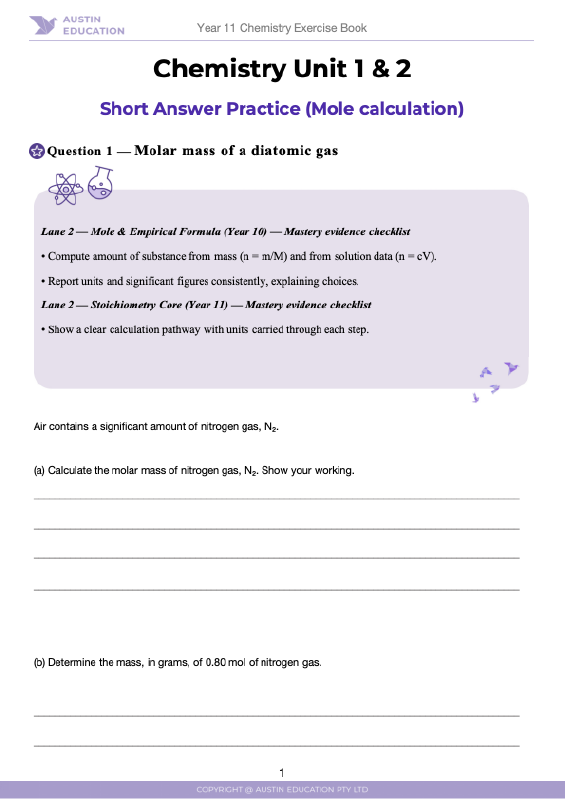
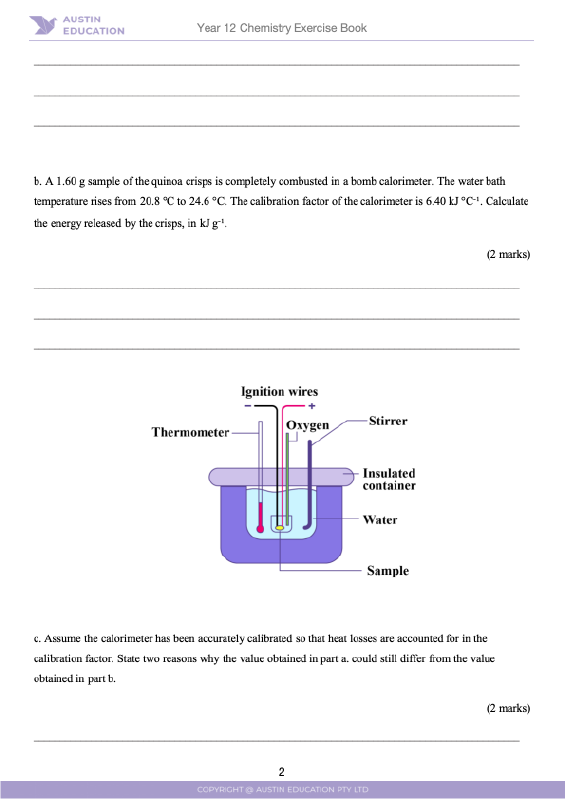
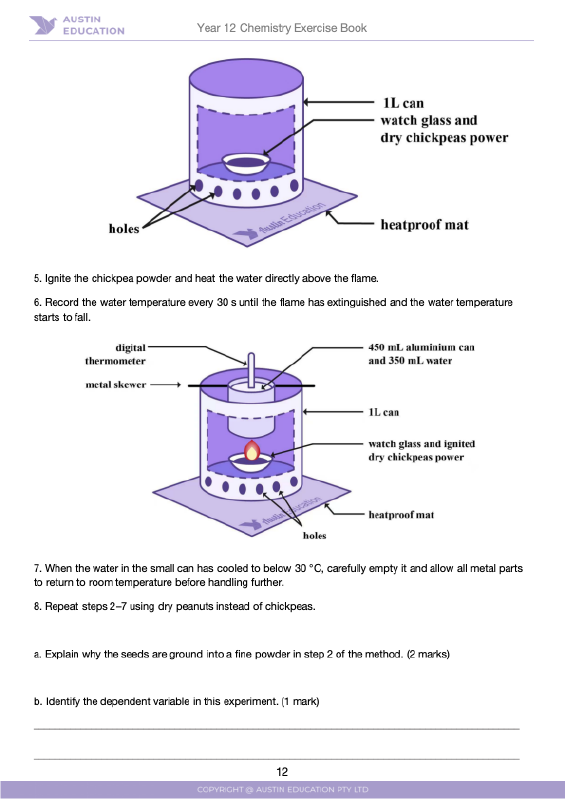
The workbooks below are the physical form of that routine. Every Austin Chemistry student works through a lane-based exercise book each term, with mastery-evidence checklists printed against the study design dot points and full working space for every calculation.
Exam Technique: The Difference Between 35 and 45
Many students who understand the content still fall short of their potential study score due to poor exam technique. The VCE Chemistry exam is 2 hours and 30 minutes long, plus 15 minutes of reading time. The following strategies are consistently emphasised in Austin Education's VCE Chemistry program.
Use Reading Time Strategically
Skim Section B and allocate time per question. Read the extended response and brainstorm key concepts. Mentally attempt multiple-choice questions.
Allocate Time by Marks
Spend approximately 1.5 minutes per mark in Section B. A 6-mark question deserves 9 minutes. Never spend 15 minutes on a 3-mark question.
Always Include Units and States
Failing to include units in numerical answers or state symbols in equations is one of the most common — and most avoidable — ways to lose marks.
Show All Working
Partial marks are available for correct working even if the final answer is wrong. Never write only the final answer for a multi-step calculation question.
Structure Extended Responses
Plan before you write. Use the mark allocation as a guide to how many distinct points are required. Each mark typically requires one distinct, accurate statement.
Use the Updated Data Book
Familiarise yourself with the 2024 Data Book. Know exactly where to find green chemistry principles, the solubility table, and organic functional group structures.
The most common exam mistakes (from VCAA examiner reports):
- Failing to include units or significant figures correctly
- Writing incomplete ionic equations — missing state symbols
- Not reading the question carefully — especially confusing "explain" with "describe"
- Skipping reading time — use every minute of it
- Not showing working for multi-step calculations
- Leaving extended response questions blank rather than attempting them for partial marks
Getting Support
When to Consider VCE Chemistry Tuition in Melbourne
VCE Chemistry is one of the most demanding science subjects in the Victorian Certificate of Education. While many students manage the subject independently, there are specific situations where structured tuition can make a significant difference — not just to study scores, but to a student's confidence and enjoyment of the subject.
Signal 1 — Conceptual Gaps from Early in the Year
VCE Chemistry builds on itself. If you are struggling with stoichiometry or redox in Unit 3, it is likely that gaps from Unit 1 or 2 are contributing. Targeted tuition can identify and fill these gaps before they compound.
Signal 2 — SAC Results Below Expectation
A SAC result that does not reflect your effort is a clear signal that your study approach needs adjustment. A tutor can review your SAC responses, identify where marks were lost, and restructure your preparation for the next assessment.
Signal 3 — Targeting a Study Score of 40+
Students aiming for medicine, pharmacy, or engineering prerequisites often need a Chemistry study score of 35–40+. Reaching this level requires more than completing homework — it requires systematic exam preparation, extended response practice, and exposure to the full range of VCAA question types.
Signal 4 — Navigating the New Study Design
With the 2024 updates, past exams prior to 2024 don't fully align with the current curriculum. Structured tuition provides up-to-date practice materials and expert guidance on new topics like green chemistry and medicinal chemistry.
Austin Education's VCE Chemistry Program
Austin Education's VCE Chemistry program is designed around the 2024–2027 VCAA study design, with all teaching materials updated to reflect the latest exam trends, new content areas, and assessor reports.
| Preparation Area | Without Structured Support | With Austin Education |
|---|---|---|
| Study Design Coverage | Relies on school pacing — gaps often undetected | Systematic coverage of every dot point, updated for 2024+ |
| SAC Preparation | Self-directed, limited practice materials | Practice SACs, detailed feedback, targeted revision |
| Exam Technique | Developed through trial and error in actual exams | Explicitly taught: time management, command terms, extended response structure |
| Past Paper Practice | Completed independently, risk of outdated questions | Curated practice relevant to the new study design with expert feedback |
| Extended Response | Often neglected until close to the exam | Practised throughout the year with structured feedback on every response |
Frequently Asked Questions
VCE Chemistry FAQs
What is the VCE Chemistry study design for 2024–2027?
The current VCE Chemistry study design runs from 2023 (Units 1 & 2) and 2024 (Units 3 & 4) through to 2027. Unit 3 covers current and future options for supplying energy, and optimising the rate and yield of chemical reactions. Unit 4 covers the categorisation and synthesis of organic compounds, as well as their analysis and use (including medicinal chemistry). The study design is published by VCAA and all SACs and the final exam are set according to its outcomes and areas of study.
How is VCE Chemistry scored?
VCE Chemistry study score is calculated from Unit 3 SAC (20%), Unit 4 SAC (30%), and the final VCAA exam (50%). The exam is 2.5 hours long, covering all key knowledge and key skills that underpin the outcomes in Units 3 and 4. A study score of 40 places you in approximately the top 9% of students. VCE Chemistry is a moderately scaled subject — a raw score of 40 typically converts to approximately 42–44 in the ATAR calculation.
What topics are in VCE Chemistry Unit 3?
VCE Chemistry Unit 3 covers two areas of study: (1) Energy options — including fossil fuels, biofuels, combustion, calorimetry, and galvanic/fuel cells; and (2) Optimising chemical reactions — including reaction rates, equilibrium systems, Le Chatelier's Principle, and electrolytic cells. Unit 3 focuses heavily on applying stoichiometry and thermochemistry to energy production and industrial processes.
What topics are in VCE Chemistry Unit 4?
VCE Chemistry Unit 4 covers two areas of study: (1) Organic compounds categorisation and synthesis — including functional groups, IUPAC naming, reaction pathways, metabolism of macromolecules, and green chemistry principles (renewable feedstocks, catalysis, and designing safer chemicals); and (2) Organic compounds analysis and use — covering MS, IR, ¹H NMR, ¹³C NMR, HPLC, redox titrations (excluding back titrations), and medicinal chemistry including enzyme structure (primary to quaternary), lock-and-key competitive inhibition, and extraction/purification of natural compounds.
How do I prepare for VCE Chemistry SACs?
Effective VCE Chemistry SAC preparation involves: (1) completing targeted content revision aligned to each SAC's area of study using the study design as a checklist; (2) practising with past SAC-style questions under timed conditions; (3) reviewing VCAA exam reports for commonly tested concepts; (4) seeking detailed feedback on written responses; and (5) mastering command terms — knowing the difference between "explain", "describe", "calculate", and "identify" is critical for maximising marks on written responses.
What is a good VCE Chemistry study score?
A study score of 40 places you in approximately the top 9% of VCE Chemistry students. A score of 45 is in the top 2%, and a score of 50 (the maximum) is achieved by fewer than 0.5% of students. For medicine and pharmacy prerequisites, a study score of 35+ is typically required, though competitive applicants often aim for 40+. Because VCE Chemistry is a moderately scaled subject, a raw score of 40 typically contributes approximately 42–44 to your ATAR calculation.
When should I start VCE Chemistry tuition?
The ideal time to start VCE Chemistry tuition is at the beginning of Unit 3 (Year 12). However, students who begin in Unit 1 or 2 build stronger foundational skills and tend to perform more consistently throughout the year. If you are already in Unit 3 or 4, it is never too late — targeted tuition can make a significant difference even in the final weeks before the exam. Austin Education offers a trial lesson for new students.
How long is the VCE Chemistry exam?
The VCE Chemistry final exam is 2.5 hours long, plus 15 minutes of reading time. The exam covers all Unit 3 and Unit 4 content, including all key knowledge and key skills, and is worth 50% of your final study score. The exam is held in November and is set by VCAA.
Ready to Achieve Your Target Study Score?
Book a trial lesson with Austin Education's VCE Chemistry specialists, or speak with our team about which program is right for you.
Book a Trial Lesson- ✓40+ Average Score Target
- ✓VCE Specialist Teachers
- ✓Trial Lesson Available
- ✓Updated for 2024–2027 Study Design
Explore the VCE Chemistry course to see the full curriculum, materials and teaching team, or speak with our team about which program suits your year level.
Continue Reading
Related Articles
- Why Most Students Never Break 40 in VCE Chemistry — the hidden mistakes that stop hard-working students reaching a raw 40+.
- What is the UCAT? A Complete Guide for Australian Students — Chemistry is a medicine prerequisite; this is what comes next on that pathway.
- VCE Subject Scaling: Choosing Subjects Strategically — where Chemistry sits against other VCE subjects in the ATAR calculation.
Austin Education is Melbourne's leading provider of VCE Chemistry tuition, with campuses in Box Hill, Mount Waverley, Melbourne CBD, Ormond and Point Cook, and live online classes across Australia.
By Joshua Ren — Head of Chemistry, Austin Education · Doctor of Medicine, GP Registrar
Reviewed by Jason Wallace — Principal Author of the VCAA VCE Chemistry Study Design · former Assistant Chief Examiner
Published · Last updated