

VCE Maths Methods & Specialist Maths Raw 50 Study Tips: How a Top Student Achieved Perfect Scores
Real strategies from Sandy — Raw 50 in Methods, Raw 50 in Specialist, McKinnon Secondary College graduate.
- 9 min read
- Melbourne, VIC
- For VCE Students & Parents
Quick Summary
What separates VCE Maths Methods & Specialist raw 50 scorers from the rest?
According to Sandy, a 99.90 ATAR graduate, it comes down to three core habits: completing every foundational textbook exercise to build "muscle memory," using a data-driven error log to systematically eliminate weak points, and mastering exam-specific technique — including answering extended response before multiple-choice in Exam 2. Austin Education provides the accelerated curriculum, elite resources, and VCAA examiner-level teaching that makes these strategies achievable for motivated students.
Key Takeaways
- 1Foundation First: Completing every textbook exercise builds the essential "muscle memory" that makes complex exam questions manageable.
- 2Data-Driven Revision: Tracking errors in a spreadsheet and creating a visual breakdown of mistake categories transforms revision into a targeted, efficient process.
- 3Exam Order Strategy: Always complete extended response questions before multiple-choice in Exam 2 to protect marks where guessing is not possible.
- 4Advance Learning Pays Off: Taking Methods in Year 11 dramatically reduces Year 12 workload and allows deeper mastery of each remaining subject.
- 5Mindset Over Competition: Comparing yourself only to your own previous performance, not to peers, is a more productive and psychologically healthy approach to improvement.
Student Profile
Meet Sandy: ATAR 99.90, Raw 50 in Methods & Specialist

Many VCE Maths students spend hours doing practice questions but see little improvement in their SAC and exam results. They understand the concepts in class but struggle to translate that knowledge into high marks under exam conditions. Sandy, a graduate of McKinnon Secondary College, faced the same challenge — and overcame it with a set of precise, replicable strategies. His journey from aiming for a 40 in Methods to achieving a perfect raw 50 in Year 11, and ultimately an ATAR 99.90, offers a blueprint for any student serious about VCE Mathematics.
Strategy 1
Building Strong Foundations: The Key to Long-Term Success
A common mistake students make is rushing into practice exams before fully mastering the fundamental concepts. Skipping textbook questions and jumping straight to past papers often results in a fragile knowledge base that breaks down under the pressure of complex exam questions. This is especially true in Mathematical Methods, where exam questions can be highly unpredictable.
"I did every single question in the Cambridge textbook for Methods. Many students skip straight to past papers, but if your foundational knowledge is weak, it becomes the biggest hurdle during final exam preparation. You need that muscle memory from hundreds of basic questions before you can tackle complex variations."
Sandy also shared a strong perspective on skipping Mathematical Methods and moving directly into Specialist Mathematics. He observed peers who underestimated Methods and later struggled without the foundational understanding of functions and algebraic intuition that it develops. The risk is not only about grasping content, but also about building the mathematical instinct to anticipate how a question is likely to unfold.
"After studying Methods, you develop a feel for equations. You can look at a problem and sense where it's going — whether it's asking about a parameter, an intersection, or a gradient. Without Methods, that intuition simply doesn't develop, and it matters in Specialist."
How Austin Education Helps
- Structured curriculum that ensures foundational concepts are thoroughly covered before advancing to complex applications
- Comprehensive workbooks curated with high-quality questions, including rare pre-2006 VCAA exam questions not available elsewhere
- Accelerated pace means students complete the curriculum weeks ahead of their day school, allowing more time for consolidation
Strategy 2
Turning Mistakes into Progress Through Data-Driven Revision
Practising maths is not just about doing more questions — it is about learning from mistakes in a systematic way. Many students briefly review their errors and move on, only to repeat the same mistakes in the next exam. Sandy developed a highly analytical approach that turns revision from guesswork into a focused, targeted improvement strategy.
"After every practice exam, I logged all my mistakes into an Excel spreadsheet. After doing dozens of exams, I created a pie chart categorising my errors — whether it was a specific area of study like functions or complex numbers, or arithmetic errors and sign mistakes. This showed me exactly what I needed to watch out for in the actual exam. I printed that chart and kept it in my bound reference for Exam 2."
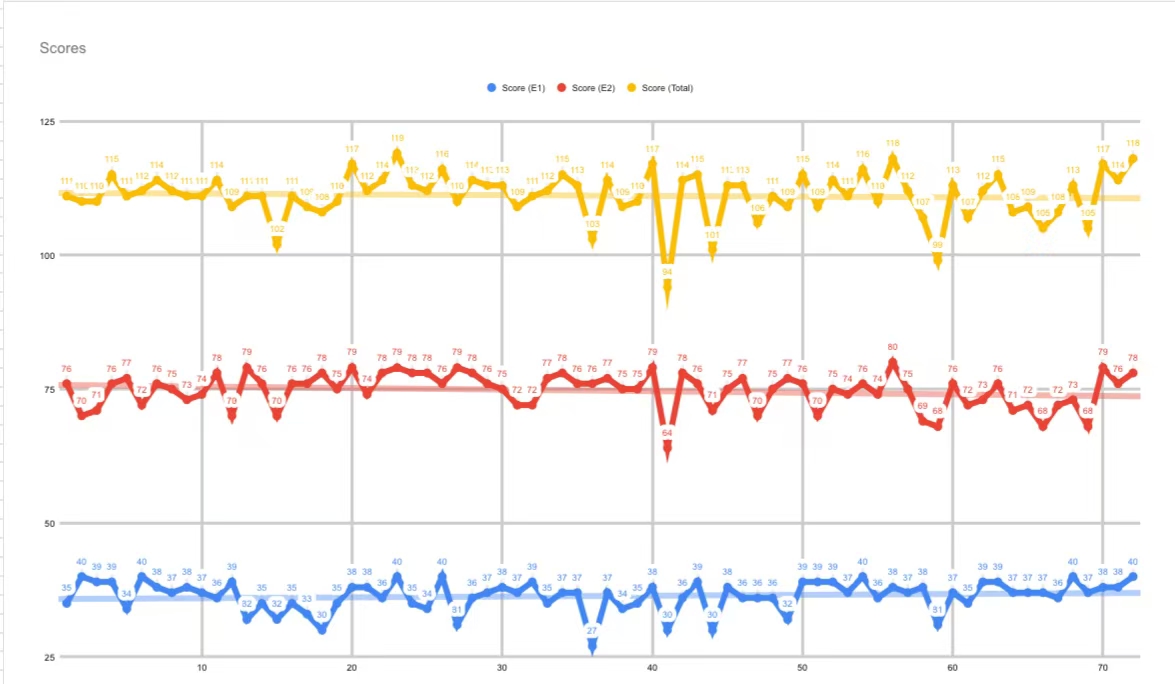
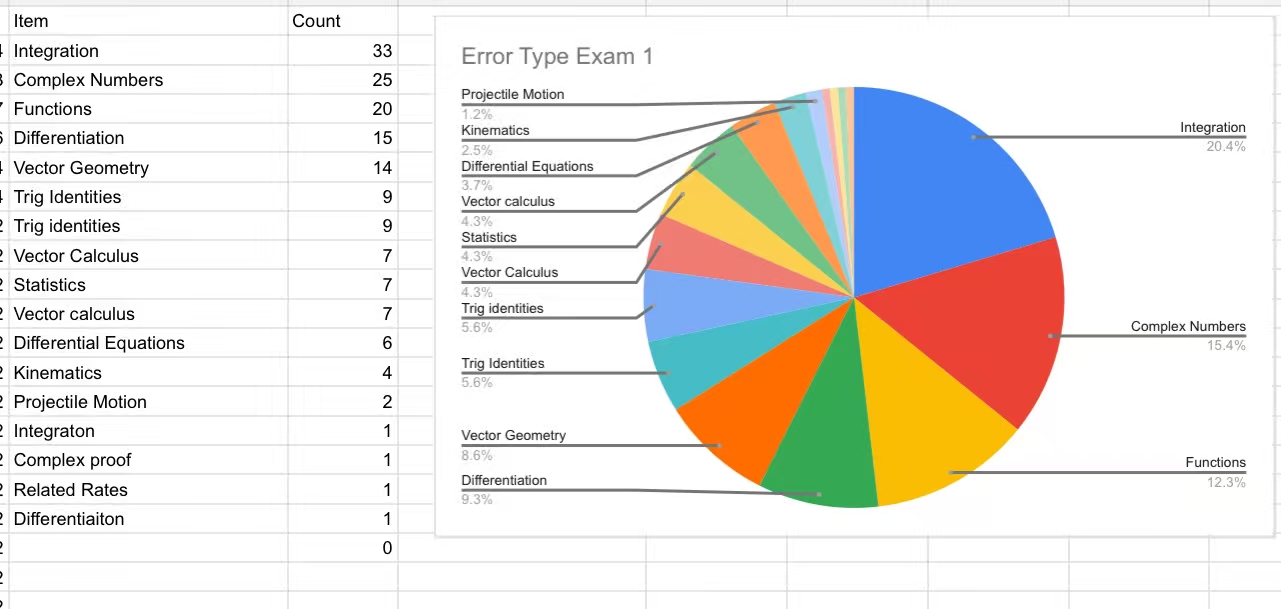
This approach is particularly powerful because it converts subjective feelings about weaknesses into objective data. Instead of vaguely knowing "I'm not great at probability," Sandy could see exactly how many probability errors he made compared to other topics, and what type of error it was — conceptual, procedural, or careless.
SandyATAR 99.90 · On the Error Log Method"I recommended this to my classmates but almost no one listened — they said it was too much effort. But when I finished, I felt a real sense of achievement, and more importantly, it was genuinely useful. The key is you need at least 50 full practice exams (Exam 1 + Exam 2) for the data to be meaningful enough to reference."
How Austin Education Helps
- Victoria's most VCAA-aligned mock exams, providing high-quality data for error analysis
- Detailed feedback on practice exams to help students understand not just what went wrong, but why
- Extensive question bank covering all topic areas, enabling targeted practice on identified weak points
Strategy 3
Mastering Exam Technique and Time Management
Knowing the mathematics is only half the battle. The other half is knowing how to navigate the exam efficiently. Poor time management and losing marks on technicalities — such as missing required working steps — are among the most common reasons strong students underperform in VCE Mathematics.
The Extended Response First Rule
"For Exam 2, always do the extended response questions before the multiple-choice. If you run out of time, you can guess multiple-choice questions — with only 4 options now, you have a 25% chance. But you can't guess extended responses. This is something Austin teachers always emphasise, and my classmates who followed this advice in the actual exam confirmed it worked."
The Two-Minute Skip Rule
Sandy recommends using a watch during exams — placed on the desk, not worn — to monitor time spent on each question. If stuck for more than two minutes, skip and move on. The brain, he notes, often continues processing the problem subconsciously, and returning to it later frequently yields a solution.
Using Reading Time Strategically
"During reading time, I scan the entire paper to identify which questions look easiest and which look hardest. I start with the easiest ones to build confidence and momentum. Spending too long on a hard question early on can cost you marks on questions you could easily answer later."
How Austin Education Helps
- Teachers demonstrate exactly which steps must be shown for each mark, and which shortcuts are safe to use
- Regular mock exams under strict timed conditions, including reading time, to build real exam stamina
- Instruction from teachers who have served as VCAA examiners, providing insider knowledge on how marks are awarded
Strategy 4
The Benefits of Studying Methods in Year 11
Sandy is unequivocal on this point: for capable students, taking Mathematical Methods in Year 11 is one of the best decisions they can make for their VCE journey. The reasoning is straightforward — managing five or more subjects simultaneously in Year 12 is genuinely difficult, and the quality of preparation for each subject inevitably suffers.
"I genuinely believe that if you ask me whether to recommend taking Methods early, the answer is absolutely yes. In Year 11, I could dedicate most of my time to just one or two subjects. The Year 11 day school subjects are relatively less critical, so I had more time to really understand the Methods content deeply. I think my Year 11 Methods score was actually higher than it would have been in Year 12 because of this."
SandyATAR 99.90 · On the Austin Advantage"Austin runs about two to three weeks ahead of my day school. So when the teacher at school covers a topic, I've already seen it at Austin. I'm not learning it for the first time — I'm consolidating. In a way, my day school became my second school, and Austin was where I actually built my foundation."
Strategy 5
The Right Mindset: Compare Yourself to Yesterday, Not to Others
One of the most underrated factors in high VCE performance is psychology. The habit of constantly comparing scores with peers — especially after exams — can create significant anxiety and derail even well-prepared students. Sandy's approach is refreshingly pragmatic and focused on controllable factors rather than external comparisons.
"I only compare myself to my own previous performance. If I scored 106 on my last practice exam and 116 on this one, that's progress. I don't care if someone else finished Exam 1 in 18 minutes. Their ability has nothing to do with mine. After exams, I would literally run out of school immediately to avoid the group answer-checking sessions. It's a waste of energy that can only hurt your mindset before the next paper."
Sandy also emphasises the importance of sleep — a factor that is chronically undervalued by VCE students. He adjusted his sleep schedule to 9pm–7am in the months before exams, ensuring his brain was at peak performance during the 9am–10:15am exam window.
"I can say with confidence: if you put me in last year's Methods exam but had me sleeping at 1am every night, I would not have scored a 40. Sleep is not optional. Your brain needs to be awake and sharp at 9am, not still warming up."
With vs Without Austin
The Difference Austin Education Makes
✗ Without Austin Education
- Learning content for the first time at school, with no prior exposure
- Limited access to high-quality, VCAA-aligned practice materials
- No systematic guidance on which steps to write for each mark allocation
- Exam preparation relies on school-provided materials, which may not reflect VCAA difficulty
✓ With Austin Education
- Curriculum 2–3 weeks ahead of day school; school time used for consolidation
- Access to curated workbooks with rare historical VCAA questions and new study design content
- VCAA examiner-level instruction on mark allocation and answer presentation
- Victoria's most VCAA-aligned mock exams, with ranking and detailed feedback
Common Questions
VCE Maths: Your Questions Answered
How do I improve my VCE Maths score?
Focus on building a solid foundation first by completing all textbook exercises, then use a data-driven error log to track and eliminate your specific mistakes. Practice under strict exam conditions to improve time management and exam technique. Avoid the trap of doing many practice exams without reviewing errors systematically.
How many practice exams should I complete for VCE Maths?
While quality matters more than quantity, top students like Sandy complete 50 or more full practice exams (Exam 1 + Exam 2) per subject. This volume is necessary to build a meaningful error dataset and to develop familiarity with all possible question variations. In the final weeks, even scanning through exams without fully completing them can be a time-efficient way to maximise exposure.
Should I learn Mathematical Methods before Specialist Mathematics?
Yes. Methods provides the essential foundational skills in functions and algebra that are critical for success in Specialist Mathematics. Without Methods, students lack the mathematical intuition to sense where Specialist questions are heading. Attempting Specialist without a strong Methods foundation carries significant risk of underperformance.
Is it worth taking VCE Mathematical Methods in Year 11?
For capable students, absolutely. Taking Methods in Year 11 significantly reduces the Year 12 workload, allows deeper mastery of the subject due to reduced competition for study time, and gives students a full year of consolidation before the final exam. Sandy achieved a raw 50 in Year 11 and attributes this partly to having more dedicated study time than he would have had in Year 12.
What is the best strategy for VCE Maths Exam 2?
Always complete the extended response questions before the multiple-choice questions. If you run out of time, you can make educated guesses on multiple-choice (now only 4 options), but you cannot guess extended responses. Use reading time to identify the easiest and hardest questions, start with the easiest to build confidence, and apply the two-minute skip rule if you get stuck.
How do top students avoid careless mistakes in VCE Maths?
Top students systematically track their errors using a log or spreadsheet, categorising mistakes by type and topic. Before exams, they review this log to stay conscious of their personal weak points. Sandy took this further by creating a visual pie chart of his error categories and printing it to keep in his bound reference during Exam 2.
Can tutoring help improve VCE Maths results?
Yes. Expert tutoring at Austin Education provides accelerated learning that puts students ahead of their day school curriculum, targeted feedback on exam technique from teachers with VCAA examiner experience, and access to high-quality resources including curated workbooks and Victoria's most VCAA-aligned mock exams.
How important is sleep for VCE exam performance?
Critically important. VCE exams typically begin at 9am, and a brain that has been consistently sleep-deprived will not perform at its peak during this window. Sandy adjusted his sleep schedule to 9pm–7am in the months before exams, and attributes this as a key factor in his performance. He states that without adequate sleep, he would not have scored a 40 in Methods, let alone a 50.
Ready to Apply These Strategies?
Austin Education's VCE Mathematics courses are designed to give motivated students the tools, resources, and expert guidance to implement exactly these strategies. Join Victoria's leading VCE Mathematics program.
Book a Free Consultation →- ✓Raw 50 Methods & Specialist
- ✓VCAA Examiner-Led Teaching
- ✓Melbourne & Adelaide
- ✓Victoria's Leading Maths Program
By Austin Education VCE Maths Team
Published