

VCE Psychology: Why 18,000 Students Choose It & How to Score 40+
The complete guide to VCE Psychology — subject suitability, SAC structure, exam strategy, and university pathways.
- 11 min read
- Melbourne, VIC
- Year 10–12 Students & Parents
Quick Summary
Is VCE Psychology a good subject choice?
VCE Psychology is the third most popular VCE subject, chosen by over 18,000 students each year. It is a science subject that explores human behaviour, mental processes, and wellbeing across Units 1–4. Despite being a science, it scales down by only 1–2 points and produced 33 perfect scores in 2024 — more than Chemistry or Physics. SACs account for 50% of the final score, with the Unit 4 Scientific Poster being the most challenging component. Success requires mastering the three-step "Explain" answer formula, building strong scientific writing skills, and completing targeted mock exams.
Key Takeaways
- 1High popularity & accessibility: With 18,000+ students annually, Psychology is a balanced science subject — ideal for students strong in English, or those seeking an alternative to Physics or Chemistry.
- 2Favourable scaling: Psychology scales down by only 1–2 points, making it a reliable subject for protecting your ATAR compared with subjects like Further Mathematics.
- 3SACs account for 50%: Units 3 & 4 SACs make up half the final score, including the challenging Scientific Poster, which requires independent experiment design, data analysis, and formal report writing.
- 4The "Explain" skill is crucial: In the 80-mark written section, 43 marks test the "Understand / Explain" cognitive level. A precise three-step answer formula is the key to not losing easy marks.
- 5Strong university & career pathways: VCE Psychology mirrors the first month of a university psychology degree, opening doors to clinical psychology, HR, marketing, government, and education.
Subject Overview
Why is VCE Psychology the 3rd Most Popular Subject?
VCE Psychology is not a humanities subject — it is classified as a science. Yet it attracts over 18,000 students annually, making it the third most popular VCE subject overall, behind only English (40,000+) and General Mathematics (30,000+). This remarkable popularity stems from a unique combination of accessible content, strategic value, and genuine intellectual interest.
Who is VCE Psychology Designed For?
Based on student-profile data from VCAA exam reports, the typical high-achieving Psychology student has a distinct profile. Approximately two-thirds of the cohort are female, and top girls' schools consistently dominate the high-score rankings — Mac.Robertson Girls' High School, for example, had 41 students score 40+ in a single year. Students who excel tend to be strong in English (including EAL students), are not primarily interested in Biology, Chemistry, or Physics, and are looking for a science subject that rewards analytical writing and logical thinking over mathematical computation.
Subject Fit Checklist
Psychology is likely a strong choice if you…
…are interested in how people think, feel, and behave; have strong English reading and writing skills; want a science subject that does not require advanced maths; are looking for a subject that complements humanities or other sciences; or are considering careers in health, education, HR, or social research.
Assessment Structure
SAC Breakdown: What You Are Assessed On (50% of Final Score)
SACs (School-Assessed Coursework) account for exactly 50% of your final VCE Psychology score. This means your performance throughout the year is just as important as the final exam. Understanding the structure of each SAC is essential for strategic preparation.
| SAC | Content Focus | Format | Weight |
|---|---|---|---|
| SAC 1 | Nervous system & stress responses | Short-answer questions | Unit 3 (20%) |
| SAC 2 | Learning approaches & memory | Short-answer questions | Unit 3 (20%) |
| SAC 3 | Sleep & sleep disorders | Short-answer questions | Unit 4 (30%) |
| SAC 4 | Mental wellbeing & phobia models | Model application + short-answer | Unit 4 (30%) |
| SAC 5 | Scientific investigation (poster) | Experiment design + written report | Unit 4 (30%) |
The Scientific Poster: The Biggest SAC Challenge
The Unit 4 Scientific Poster (SAC 5) is consistently the component most students find most challenging. Unlike the other SACs, which test content knowledge, the Scientific Poster requires students to independently design a research experiment, collect and analyse data, and write a formal scientific report. Many day schools lack the time and resources to provide the level of guidance this task demands.
How Austin Education Helps with the Scientific Poster
- Step-by-step guidance on research topic selection and experiment design
- Structured templates for data collection, analysis, and interpretation
- Line-by-line report writing feedback with referencing skills training
- Practice with different assessment formats: case studies, data analysis, media analysis, literature reviews
Final Exam
VCE Psychology Exam Structure: How to Maximise Your 50%
The final exam accounts for 50% of your VCE Psychology score. It runs for 2 hours 30 minutes (plus 15 minutes reading time) and consists of two sections totalling 120 marks. In 2024, a score of approximately 185–188 out of 240 was needed to achieve a study score of 45+.
Section A · Multiple Choice — 40 marks
1 mark each, no multi-select. The foundation for securing marks: tests all four units of content and requires precise key-knowledge recall.
Section B · Short Answer — 80 marks
7–8 questions, including a 10-mark extended response each year. The key differentiator for 40+ scores — it rewards application to specific scenarios.
Mark Distribution by Cognitive Level (Section B)
High-Yield Strategies
How to Score 40+ in VCE Psychology: 4 Proven Strategies
Scoring 40+ in VCE Psychology requires more than memorising textbook definitions. The following strategies are drawn from Austin Education's teaching experience and the patterns identified in VCAA exam reports.
Master the Three-Step "Explain" Formula
The "Explain" command term is the most important in VCE Psychology, accounting for 43 of the 80 marks in the short-answer section. Many students lose marks by providing only a definition or only a theory, without connecting both to the specific scenario in the question.
- 1️⃣ Definition: precisely define the key psychological term or concept being asked about.
- 2️⃣ Theory / key knowledge: state the relevant theory, model, or key knowledge that explains the concept.
- 3️⃣ Apply to scenario: connect both the definition and theory directly to the specific scenario, person, or case study in the question.
Build a Systematic Memorisation Framework
VCE Psychology has a large volume of key knowledge that must be memorised accurately. Unlike Mathematics, where understanding the method is enough, Psychology requires precise recall of definitions, models, and research findings. Austin Education provides well-designed handouts and lesson sequences that organise this content into memorable frameworks — using mnemonics, concept maps, and spaced repetition for long-term retention. Students who rely on the textbook alone often find the content fragmented and hard to recall under exam conditions.
Conquer the Scientific Poster with Structured Guidance
The Unit 4 Scientific Poster is often the biggest hurdle, because it requires a completely different skill set from the other SACs. Success requires understanding how to design a valid experiment (variables, controls, ethical considerations), how to collect and analyse data correctly, and how to write a formal scientific report with proper referencing. Austin Education provides step-by-step guidance through every stage, from choosing a research topic to submitting the final poster.
Targeted Mock Exams to Build Exam Fluency
Because VCE Psychology is only introduced in senior years, most students have limited experience with its specific exam format. The 10-mark extended response, in particular, requires structured argumentation that takes practice to develop. Austin Education provides comprehensive mock exams formatted exactly like the VCAA final, with detailed marking feedback that pinpoints areas for improvement. Students who complete multiple full mock exams consistently outperform those who only revise content.
 Click to view full size
 Click to view full size
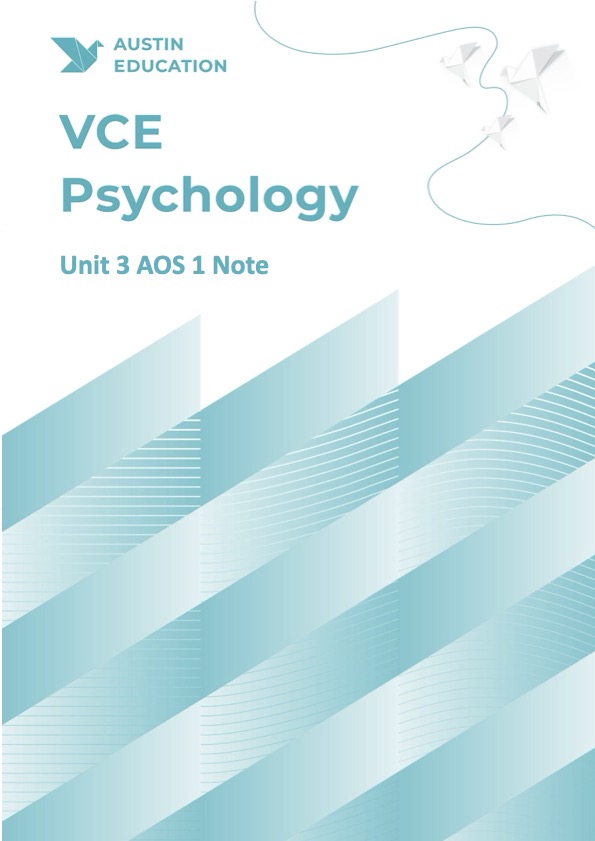
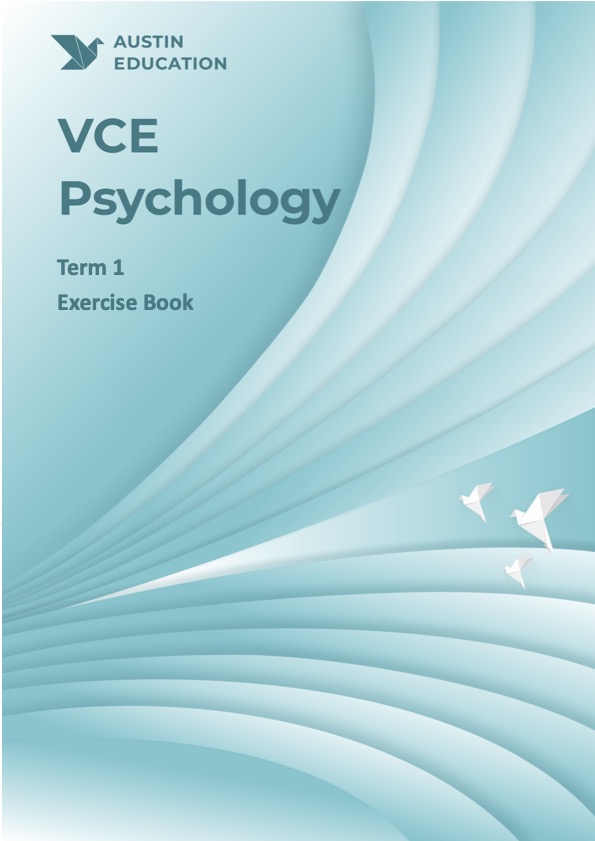
Austin Education's purpose-built VCE Psychology handouts and exercise books organise the syllabus into exam-ready frameworks — the kind of structured resource that turns scattered textbook content into reliable recall.
Scaling & ATAR
VCE Psychology Scaling: What the Numbers Actually Mean
VCE Psychology is a science subject that scales down by approximately 1–2 points — a very minor adjustment. In practical terms, a raw score of 40 contributes approximately 39 scaled points to your ATAR calculation. This is far more favourable than subjects like Further Mathematics, which can scale down significantly at higher score ranges. The table below shows the approximate scaling for VCE Psychology.
| Raw Score | Approx. Scaled Score | Change |
|---|---|---|
| 20 | 18 | −2 |
| 25 | 23 | −2 |
| 30 | 28 | −2 |
| 35 | 34 | −1 |
| 40 | 39 | −1 |
| 45 | 45 | 0 |
| 50 | 50 | 0 |
Scaling figures are indicative and vary year to year. Source: VTAC scaling data.
University Pathways
University Pathways & Career Prospects in Psychology
VCE Psychology is not just a subject — it is the foundation for one of the most respected and versatile professional pathways in Australia. The VCE curriculum closely mirrors the first month of a university psychology degree, giving students a significant academic head start.
Top Australian Universities for Psychology (World Rankings 2023)
| Australia Rank | University | World Rank | Approx. ATAR |
|---|---|---|---|
| 1 | University of Melbourne | 22 | 88–93 |
| 2 | University of Queensland | 28 | 88 |
| 3 | UNSW Sydney | 45 | ~88 |
| 4 | Monash University | 54 | 85–89 |
| 5 | University of Sydney | 63 | ~88 |
| — | Swinburne University | — | No min. ATAR (some pathways) |
How to Become a Registered Psychologist in Australia
Becoming a registered psychologist in Australia requires completing an APAC (Australian Psychology Accreditation Council) approved pathway. There are two main routes: the "4+2" pathway (3-year Bachelor's degree + 1-year Honours + 2-year Master's degree) and the "5+1" pathway (5-year accredited program + 1-year internship). The field is highly specialised, with options including clinical psychology, educational psychology, forensic psychology, sports psychology, and organisational psychology.
With vs. Without Austin
With Austin Education vs. Day School Only
Day School Only
- Limited time for individual Scientific Poster feedback
- Generic notes without exam-focused structure
- Limited mock-exam practice before the final
- No targeted training on command-term answer formulas
With Austin Education
- Step-by-step Scientific Poster guidance from design to submission
- Well-designed handouts with exam-focused lesson sequences
- Full mock exams formatted exactly like VCAA finals
- Targeted training on the three-step "Explain" formula and other command terms
VCE Psychology is the third most popular VCE subject, chosen by over 18,000 students annually, and is classified as a science despite requiring no advanced mathematics.
School-Assessed Coursework (SACs) account for 50% of the final VCE Psychology score, with the Unit 4 Scientific Poster the most demanding single component.
In the VCE Psychology written exam, 43 of the 80 short-answer marks test the "Understand / Explain" cognitive level, making a precise three-step Explain formula the highest-yield exam skill.
Frequently Asked Questions
VCE Psychology: Frequently Asked Questions
Is VCE Psychology a science or humanities subject?
VCE Psychology is classified as a science subject and is listed under the Science group for VTAC purposes. However, unlike Chemistry or Physics, it does not require advanced mathematics, making it highly accessible to students with strong English and analytical writing skills.
Does VCE Psychology scale up or down?
VCE Psychology scales down slightly, by approximately 1 to 2 points at the mid-range. For example, a raw score of 30 scales to approximately 28, and a raw score of 40 scales to approximately 39. This is a very minor adjustment compared with subjects like Further Mathematics, making Psychology a reliable choice for ATAR maximisation.
How important are SACs for VCE Psychology?
SACs account for 50% of the final VCE Psychology score. Unit 3 SACs contribute 20% and Unit 4 SACs contribute 30%. The Unit 4 Scientific Poster is particularly high-stakes and requires strong research design, data analysis, and scientific writing skills. Consistent SAC performance provides a crucial buffer for the final exam.
What is the hardest part of VCE Psychology?
Most students find the Unit 4 Scientific Poster SAC the most challenging component, as it requires independent experiment design, data collection, analysis, and formal report writing — skills day schools often lack the time to teach thoroughly. In the final exam, the 10-mark extended response is the key differentiator between the 40+ and 35 score bands.
How do I answer "Explain" questions in VCE Psychology?
A standard 3-mark Explain response requires: 1 mark for a precise definition of the key term, 1 mark for the relevant theory or key knowledge, and 1 mark for applying both to the specific scenario or case study in the question. This formula applies to most of the 80-mark short-answer section, which carries 43 marks at the "Understand / Explain" cognitive level.
What ATAR do I need to study Psychology at university?
Entry requirements vary by institution. The University of Melbourne requires approximately 88–93 depending on the degree. Monash University's Bachelor of Psychology requires around 85, and its Honours pathway around 89. Swinburne University offers a Psychological Science degree with no minimum ATAR requirement for some entry pathways.
How can Austin Education help me score higher in VCE Psychology?
Austin Education provides well-designed handouts and lesson sequences, targeted SAC preparation including practice in different assessment formats, step-by-step guidance for the Scientific Poster, comprehensive mock exams formatted exactly like the VCAA final, and proven memorisation strategies.
Ready to Achieve Your Best in VCE Psychology?
Austin Education's VCE Psychology programme provides the structured guidance, targeted mock exams, and expert Scientific Poster coaching that day schools cannot match. Give yourself the best chance of scoring 40+.
Book a Free Consultation →- ✓VCAA-Aligned
- ✓Scientific Poster Coaching
- ✓Full Mock Exams
- ✓Melbourne-Based
By Austin Education VCE Psychology Team
Published