Looking for VCE trial exams in Melbourne that build real exam confidence? At Austin Education, our experienced examination writers—including VCAA examiners on the academic team—develop original, challenging practice papers based on subject-specific VCAA requirements. Students sit timed mock exams, receive teacher marking and learn how to structure answers that earn marks in their final VCE examinations.
The quality of a VCE mock exam starts with its writers. Austin’s academic team includes VCAA examiners, experienced VCE teachers and specialist examination-paper authors. Their combined expertise in VCAA Study Designs, question construction and marking criteria helps students practise the thinking—and the answer-writing—required in VCE assessments.
VCAA examiner experience
An examiner’s understanding of VCE marking
Our mathematics academic team includes Peideng Nie, an official VCAA Mathematics examiner. Experience with examination marking helps inform the design of questions that test not just the answer, but the reasoning and working behind it.
Exam authoring experience
Decades of VCE examination-paper experience
John Kermond brings decades of VCE Mathematics teaching and exam-paper writing and review. His expertise supports precise questions, realistic mark allocation and the high standards expected of VCE practice examinations.
Established since 2014
VCE mock exam experience dating back to 2014
Austin began running VCE Mathematics mock exams in 2014 and extended its programme to English, Science, Chinese and Accounting in 2017. Years of writing papers, reviewing results and refining questions continue to shape our approach.
Challenging VCE Trial Exams That Reflect VCAA Standards
What makes a good VCE practice exam? The right level of challenge—not difficulty for its own sake. Austin creates original trial papers with higher-order questions, strong discrimination and authentic exam-style demands. Each subject’s practice is informed by its VCAA Study Design, examination specifications, question formats and marking expectations.
VCAA Study Design
Designed around actual VCE exam requirements
Question wording, command terms, paper layout and mark allocation are designed to reflect the skills assessed in the relevant VCE subject. Students learn to read precisely and respond to the question asked.
High-difficulty training
High-difficulty questions with a purpose
Unfamiliar contexts, multi-step problems and challenging analysis extend students beyond routine textbook exercises—while remaining focused on relevant VCE knowledge and skills.
Realistic exam conditions
Realistic timed examination practice
Practise managing reading time, writing time, permitted materials and paper-specific conditions. Learn to make sound decisions when the clock is running.
Why does VCAA-aligned practice matter?
VCAA examination specifications describe each subject’s format, conditions and assessment demands. Training against those requirements helps students plan responses, show the right working and allocate time effectively.
03 / Teacher marking, solutions & exam technique
Teacher-Marked VCE Mock Exams: Learn How to Write for Marks
A trial exam score is a starting point—not the end of preparation. Teacher marking, detailed marking guides and step-by-step exam reviews help students see where marks were gained, why they were missed and how to improve their responses. Austin turns exam feedback into a focused revision strategy.
01
Practise writing against the clock
Build a practical strategy for reading, planning, answering and checking within the allotted VCE exam time.
02
See exactly where marks are awarded
Compare methods, key working, explanations and final answers against the relevant marking criteria.
03
Learn examiner-style answer techniques
Understand command terms, model response structure and the level of detail needed to secure marks.
04
Use mistakes to guide the next practice
Identify recurring errors, rewrite incomplete responses and revisit the topics that need improvement.
Real marking guide example
Detailed explanations—not just an answer key
Our Mathematics marking-guide examples show intermediate working, alternative methods and individual marking points. Teacher-led review helps students understand how to communicate a complete, efficient solution.
For English, Chinese and other written-response subjects, review focuses on the structure, evidence, terminology and accuracy of the response—not simply whether the student knows the content.
Sample Austin VCE Mathematics marking guide showing worked methods, allocated marks and assessment commentary.
From Practice to Exam Technique: Real Question Comparisons
From VCE English essays to multi-step Mathematics problems, a productive mock exam review explains more than the correct answer. Explore authentic side-by-side exam examples to see the themes and problem-solving methods students can practise before the final exam.
2025 · English & EAL
Crafting a Text: Personal Journey
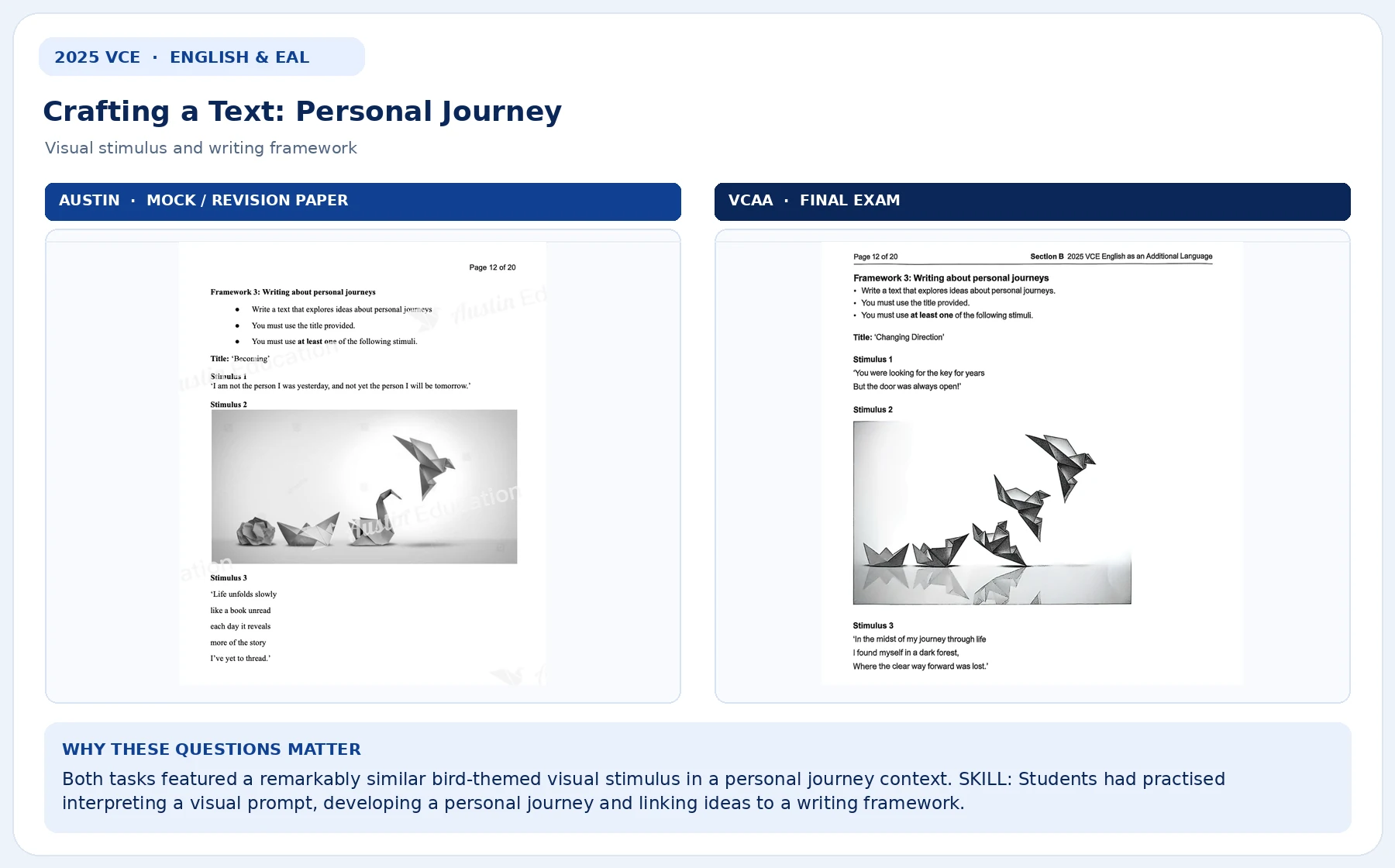
Shared exam focus: Both tasks featured a remarkably similar bird-themed visual stimulus in a personal journey context.
How this helps students: Students had practised interpreting a visual prompt, developing a personal journey and linking ideas to a writing framework.
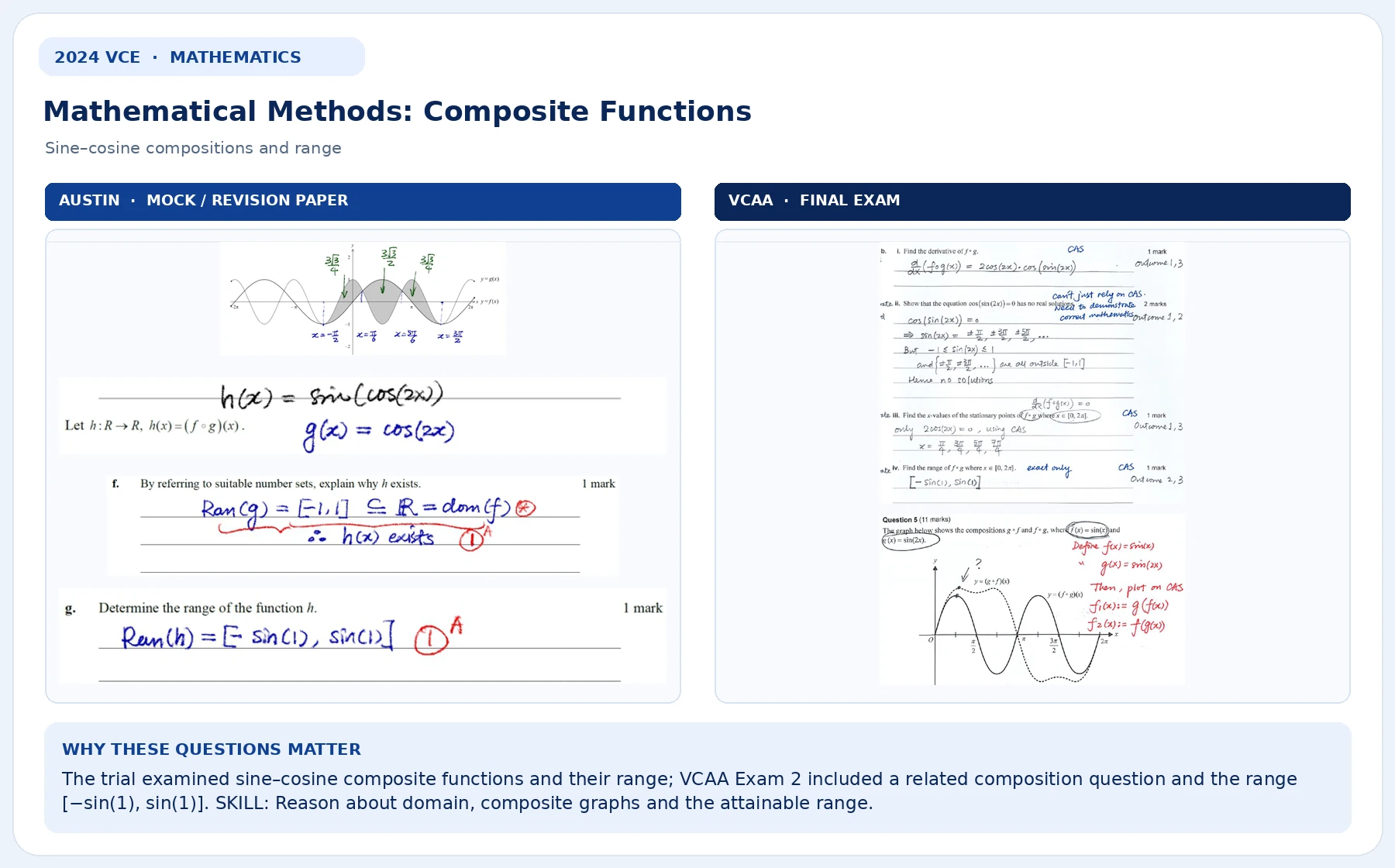
Shared exam focus: The trial examined sine–cosine composite functions and their range; VCAA Exam 2 included a related composition question and the range [−sin(1), sin(1)].
How this helps students: Reason about domain, composite graphs and the attainable range.
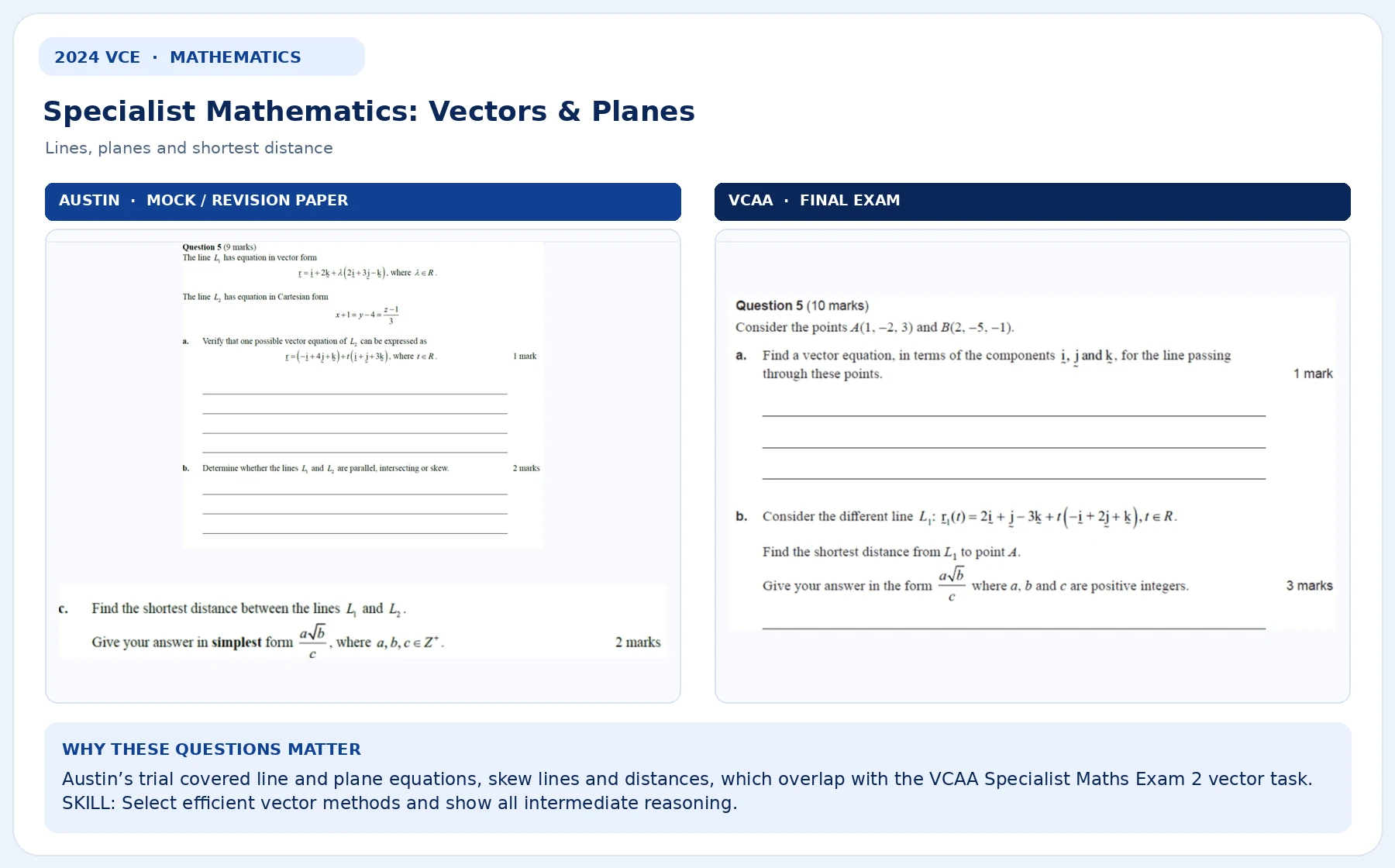
Shared exam focus: Austin’s trial covered line and plane equations, skew lines and distances, which overlap with the VCAA Specialist Maths Exam 2 vector task.
How this helps students: Select efficient vector methods and show all intermediate reasoning.
VCE Exam Topic Predictions: See Our Real Question Comparisons
How closely can VCE mock exams prepare students for the final assessments? Compare Austin Education’s original trial exams and revision materials with published VCAA questions. Explore 2025 English and EAL writing prompts, Chinese First Language listening and writing topics from 2019–2025, and 2024 Mathematical Methods and Specialist Mathematics problems. Each side-by-side example highlights an overlapping theme, skill or exam technique—not just a claimed prediction.
VCE Exam Question Comparisons: English, Chinese & Mathematics
Choose English / EAL, Chinese or Mathematics to view the original practice materials alongside VCAA exam excerpts. Use the arrows to switch examples, or select an image to enlarge it.
2025 · English & EAL
Crafting a Text: Personal Journey
Shared exam focus: Both tasks featured a remarkably similar bird-themed visual stimulus in a personal journey context.
How this helps students: Students had practised interpreting a visual prompt, developing a personal journey and linking ideas to a writing framework.
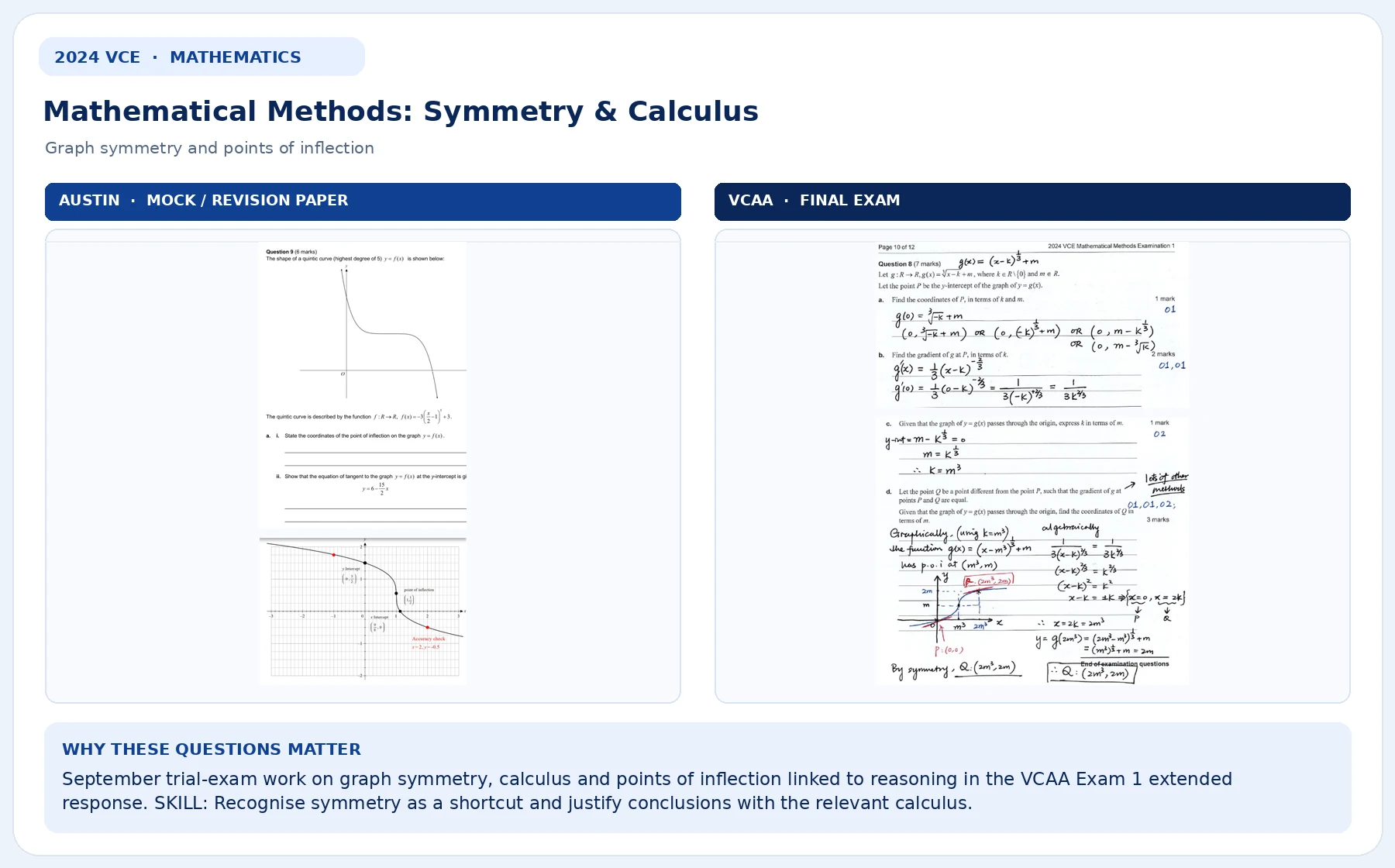
Shared exam focus: September trial-exam work on graph symmetry, calculus and points of inflection linked to reasoning in the VCAA Exam 1 extended response.
How this helps students: Recognise symmetry as a shortcut and justify conclusions with the relevant calculus.
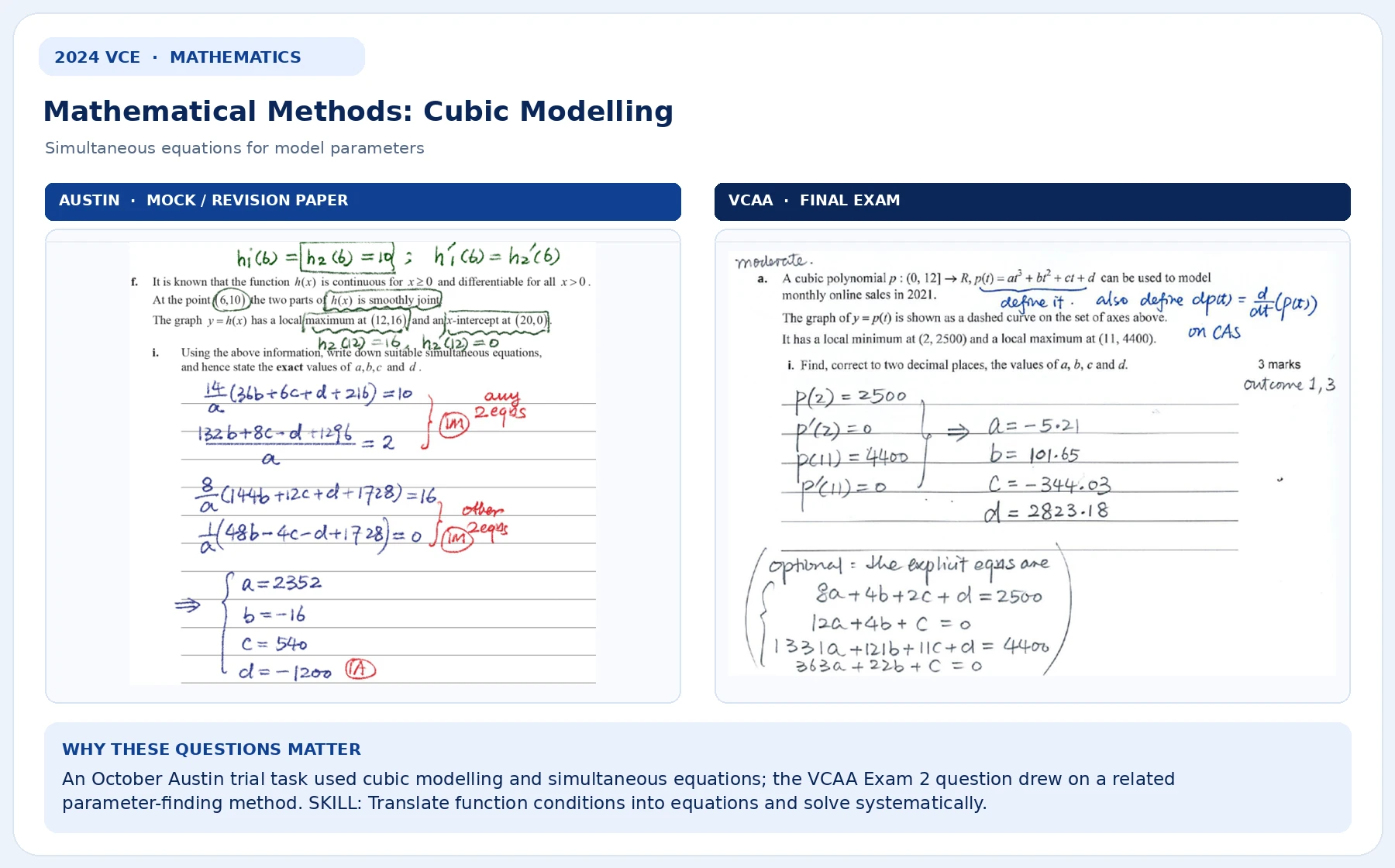
Shared exam focus: An October Austin trial task used cubic modelling and simultaneous equations; the VCAA Exam 2 question drew on a related parameter-finding method.
How this helps students: Translate function conditions into equations and solve systematically.
Shared exam focus: The trial examined sine–cosine composite functions and their range; VCAA Exam 2 included a related composition question and the range [−sin(1), sin(1)].
How this helps students: Reason about domain, composite graphs and the attainable range.
Shared exam focus: Austin’s trial covered line and plane equations, skew lines and distances, which overlap with the VCAA Specialist Maths Exam 2 vector task.
How this helps students: Select efficient vector methods and show all intermediate reasoning.
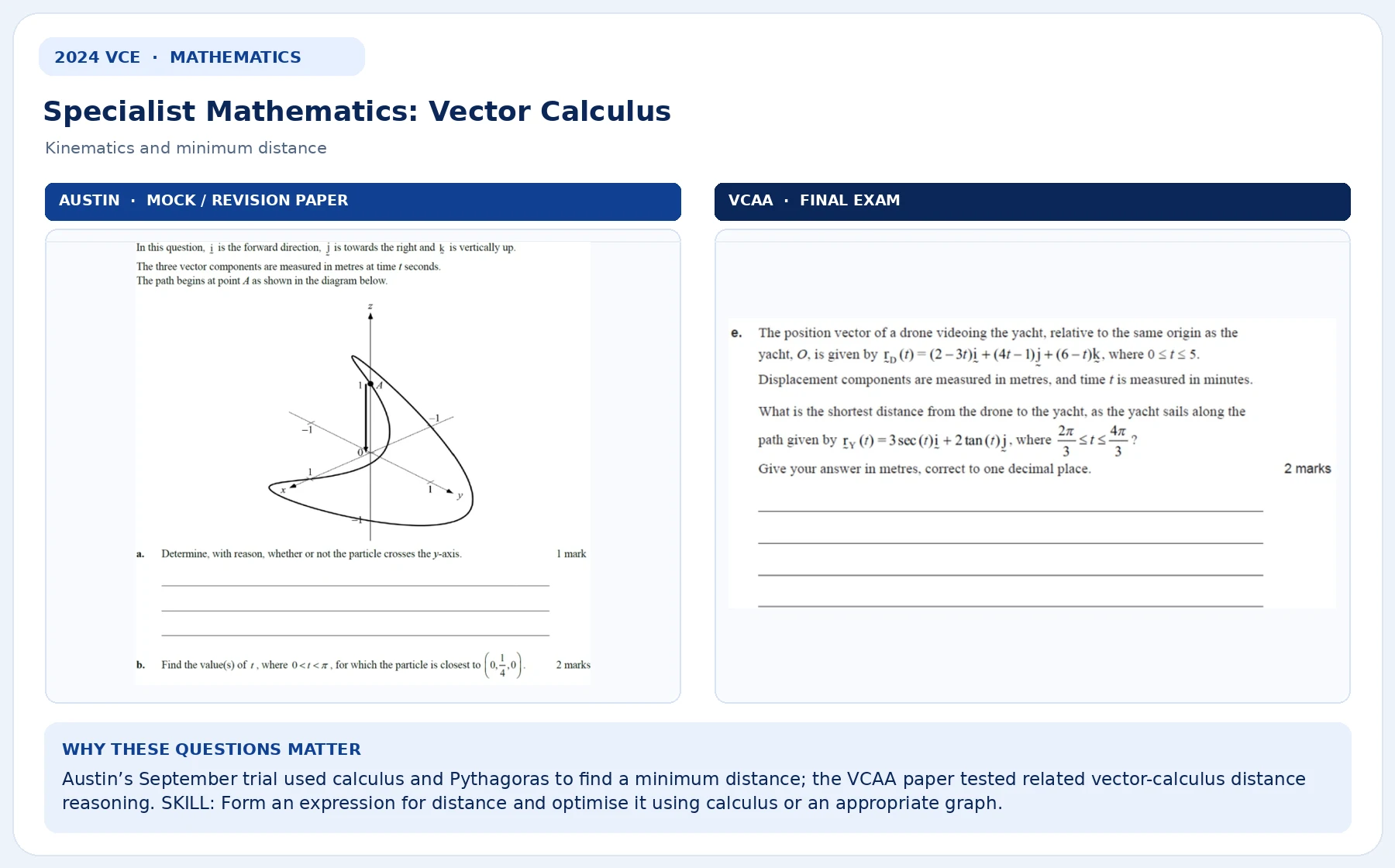
Shared exam focus: Austin’s September trial used calculus and Pythagoras to find a minimum distance; the VCAA paper tested related vector-calculus distance reasoning.
How this helps students: Form an expression for distance and optimise it using calculus or an appropriate graph.
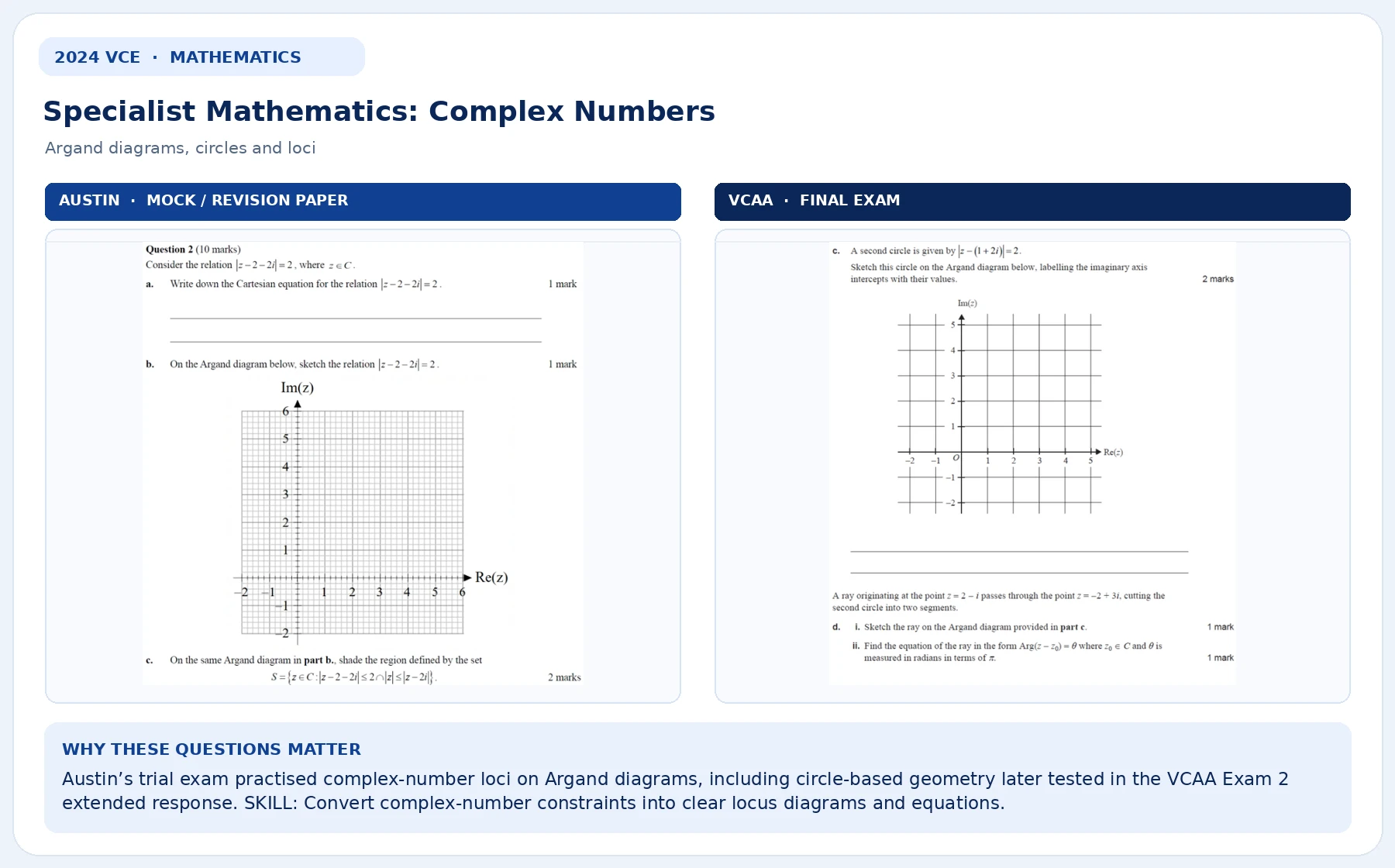
Shared exam focus: Austin’s trial exam practised complex-number loci on Argand diagrams, including circle-based geometry later tested in the VCAA Exam 2 extended response.
How this helps students: Convert complex-number constraints into clear locus diagrams and equations.
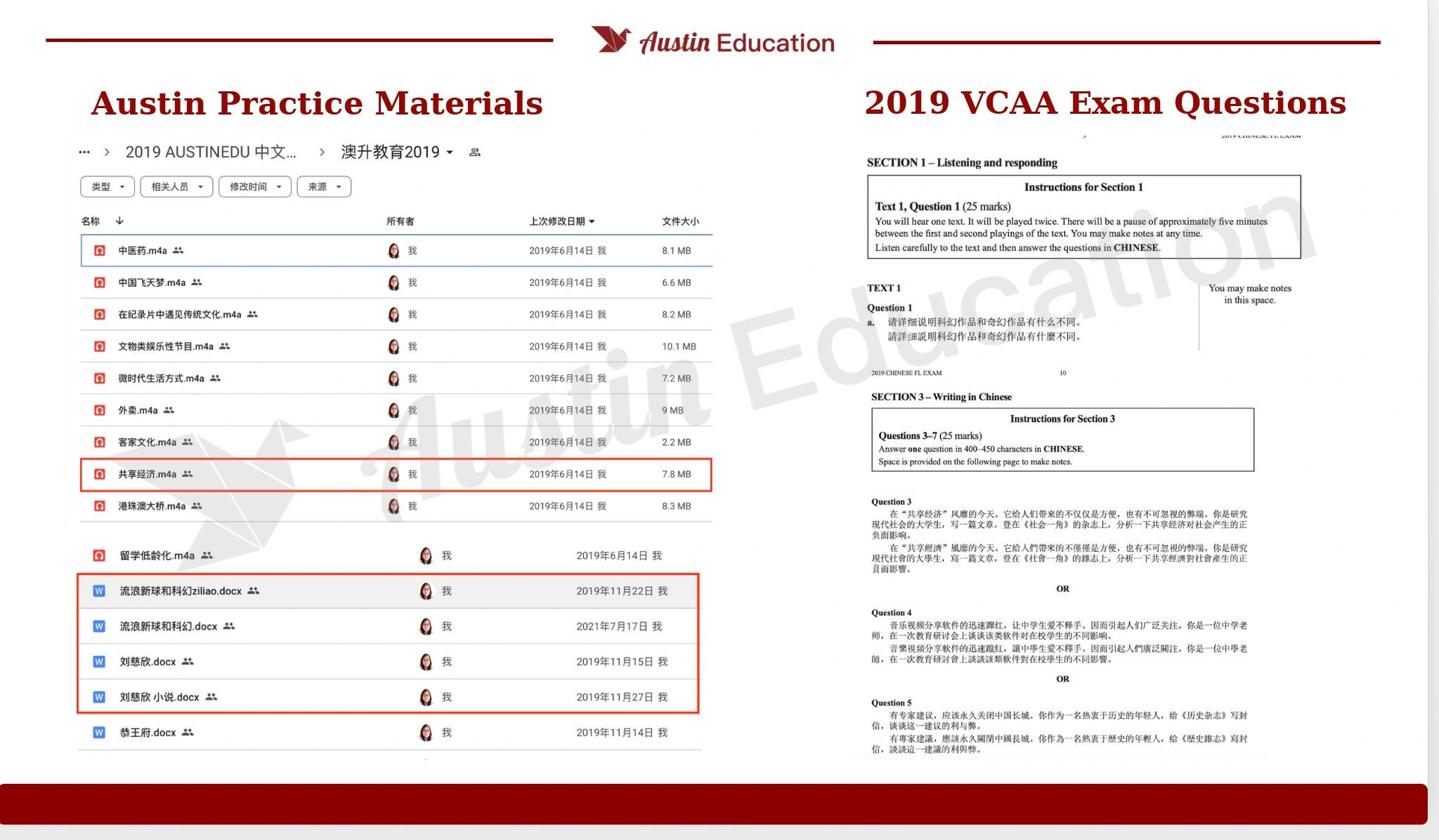
Shared topic: Austin’s earlier Chinese First Language practice materials included the sharing economy (共享经济). The 2019 VCAA Chinese First Language writing paper also addressed the opportunities and impacts of the sharing economy.
How this helps students: Preparing arguments around a contemporary social issue helps students respond to new prompts with clearer examples and a balanced evaluation.
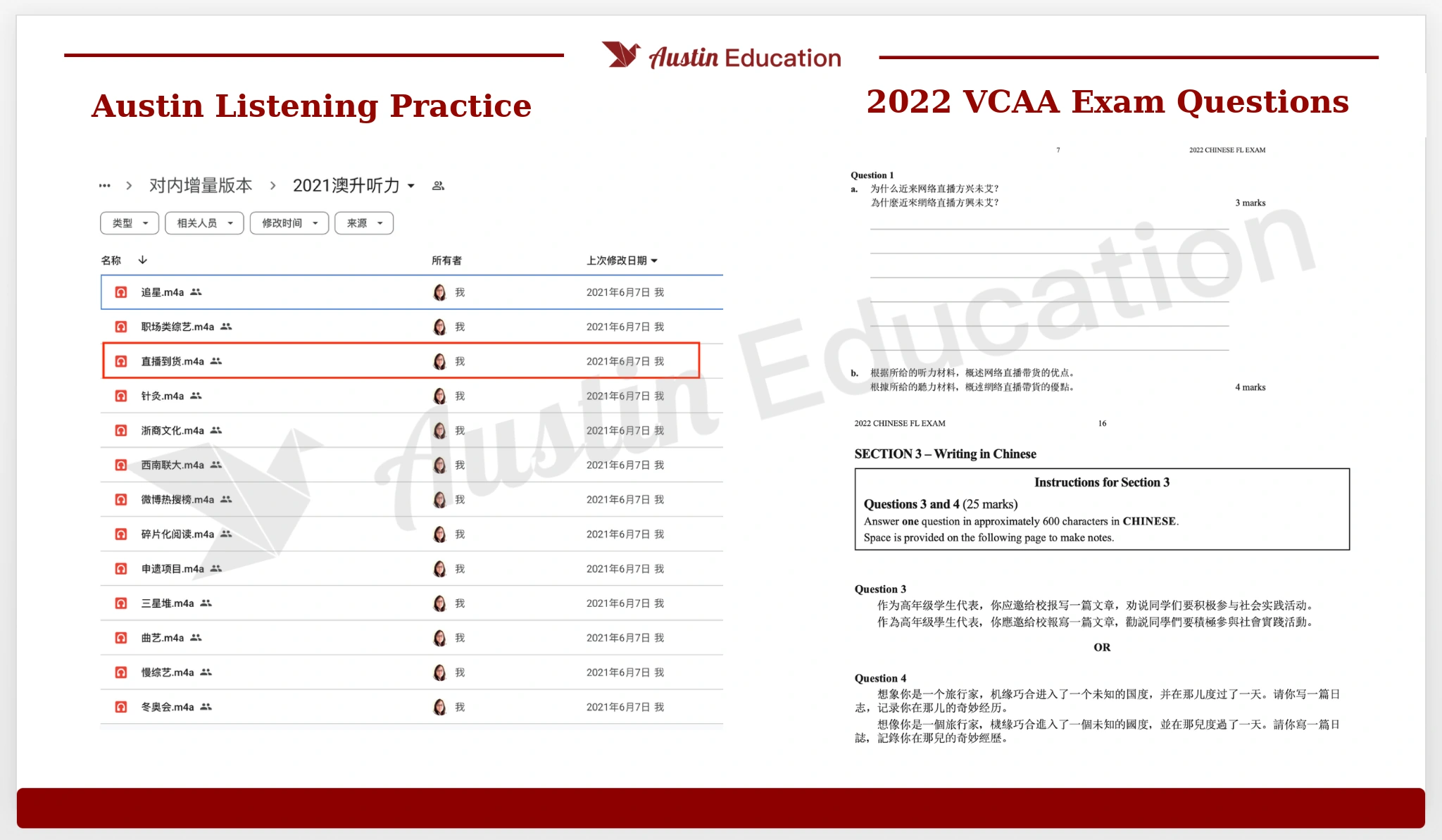
Shared topic: An Austin listening-practice resource dated 2021 addressed live-stream commerce. The 2022 VCAA Chinese First Language listening paper asked students to describe the advantages of online live-stream selling.
How this helps students: Students can build topic-specific vocabulary and practise extracting relevant points from spoken Chinese under exam conditions.
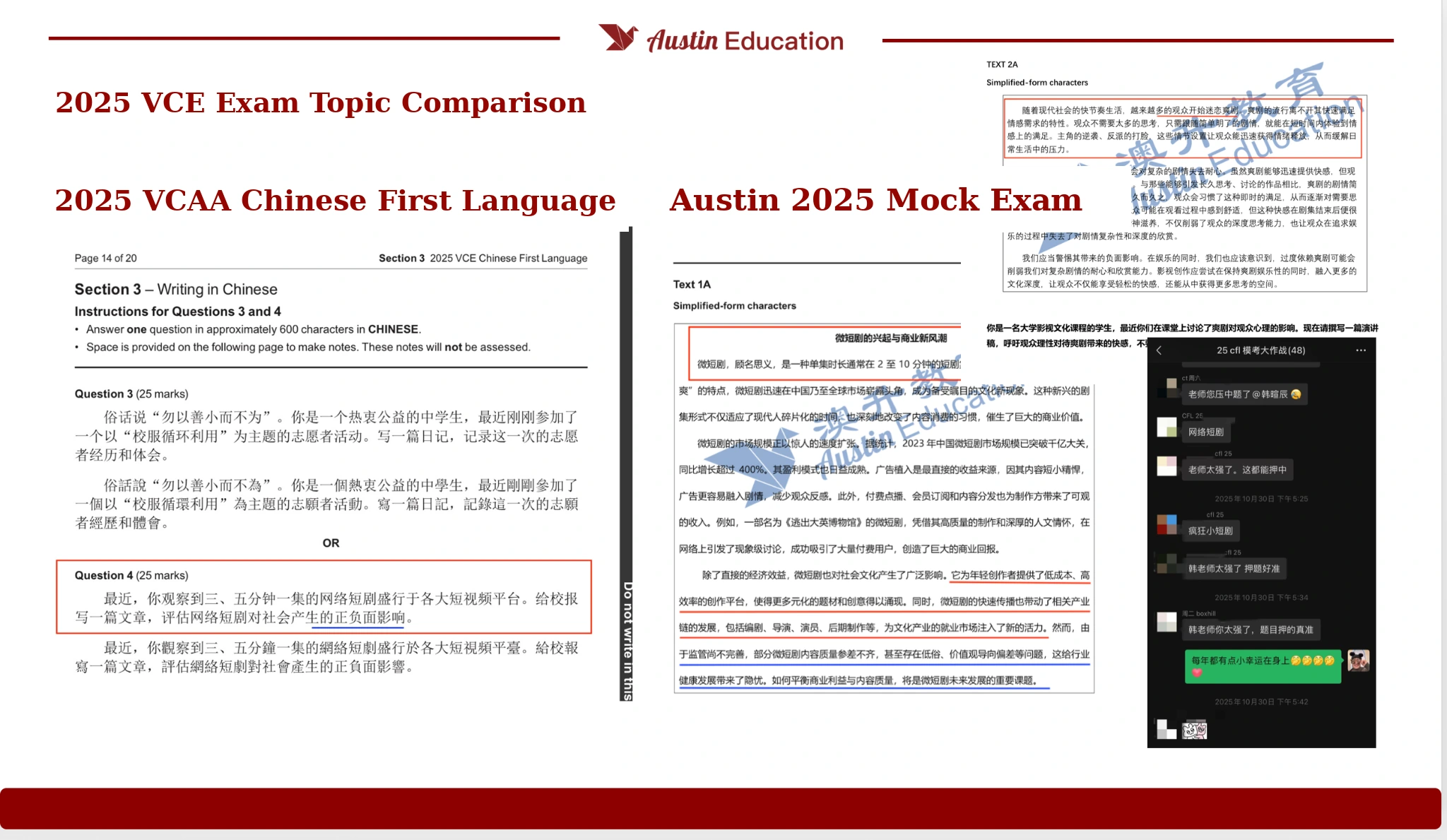
Shared topic: The 2025 VCAA Chinese First Language writing paper asked students to evaluate the social effects of online short-form dramas. Austin’s mock preparation explored the popularity, benefits and concerns associated with micro-dramas.
How this helps students: Practising a current cultural topic helps students organise evidence, assess positive and negative effects, and develop an evaluative Chinese essay.
The goal is not to memorise a predicted question. Effective VCE preparation means recognising examinable themes, adapting essay arguments to the exact prompt and using transferable mathematical methods when the context, graphs or numbers change. Our exam comparisons demonstrate that approach with real paper excerpts.
Austin offers subject-specific VCE trial exam preparation across 14 VCE subject options. From Mathematics Exam 1 and Exam 2 practice to timed English writing, Chinese responses and science questions, each subject requires its own paper format, marking criteria and revision approach.
Mathematics
VCE Maths Trial Exams
General Mathematics, Mathematical Methods and Specialist Mathematics: practise unfamiliar problems, detailed working, calculator rules and time management under exam-style conditions.
English, English as an Additional Language (EAL) and English Language: practise timed writing, close analysis, argument development and responses shaped by the subject’s assessment criteria.
Chinese Second Language, Chinese Second Language Advanced and Chinese First Language: build accuracy, written expression and subject-specific exam technique.
Practise calculations, financial interpretation and clear written responses under time pressure, with close attention to the relevant VCE Accounting requirements.
Accounting
06 / How the mock exam programme works
How Austin’s VCE Trial Exams Work: Sit, Mark, Review, Improve
A realistic mock exam becomes useful when you know what to do afterwards. Our process connects timed VCE exam practice with marking, detailed teaching and targeted follow-up revision.
01
Choose your VCE subject
Ask about your subject’s next trial exam, available dates, location and paper format.
02
Sit a timed mock exam
Practise exam pacing, response planning and working under subject-specific conditions.
03
Receive marked work
See your result and identify missing steps, unclear reasoning or marks lost through exam technique.
04
Review solutions with teachers
Learn how questions are assessed, how to write stronger answers and where each mark comes from.
05
Turn feedback into revision
Revisit weak topics, correct common errors and practise unfamiliar questions before the final exam.
07 / Genuine papers & anonymous performance data
See Original VCE Mock Exam Papers, Marking Guides & Results Data
A high-quality VCE mock exam should be transparent about what students practise and how their work is assessed. Explore authentic question excerpts from English, EAL, Mathematical Methods and Specialist Mathematics, together with Austin’s Mathematics marking guides and anonymised cohort-level results. These examples connect question design with VCAA exam preparation and meaningful feedback.
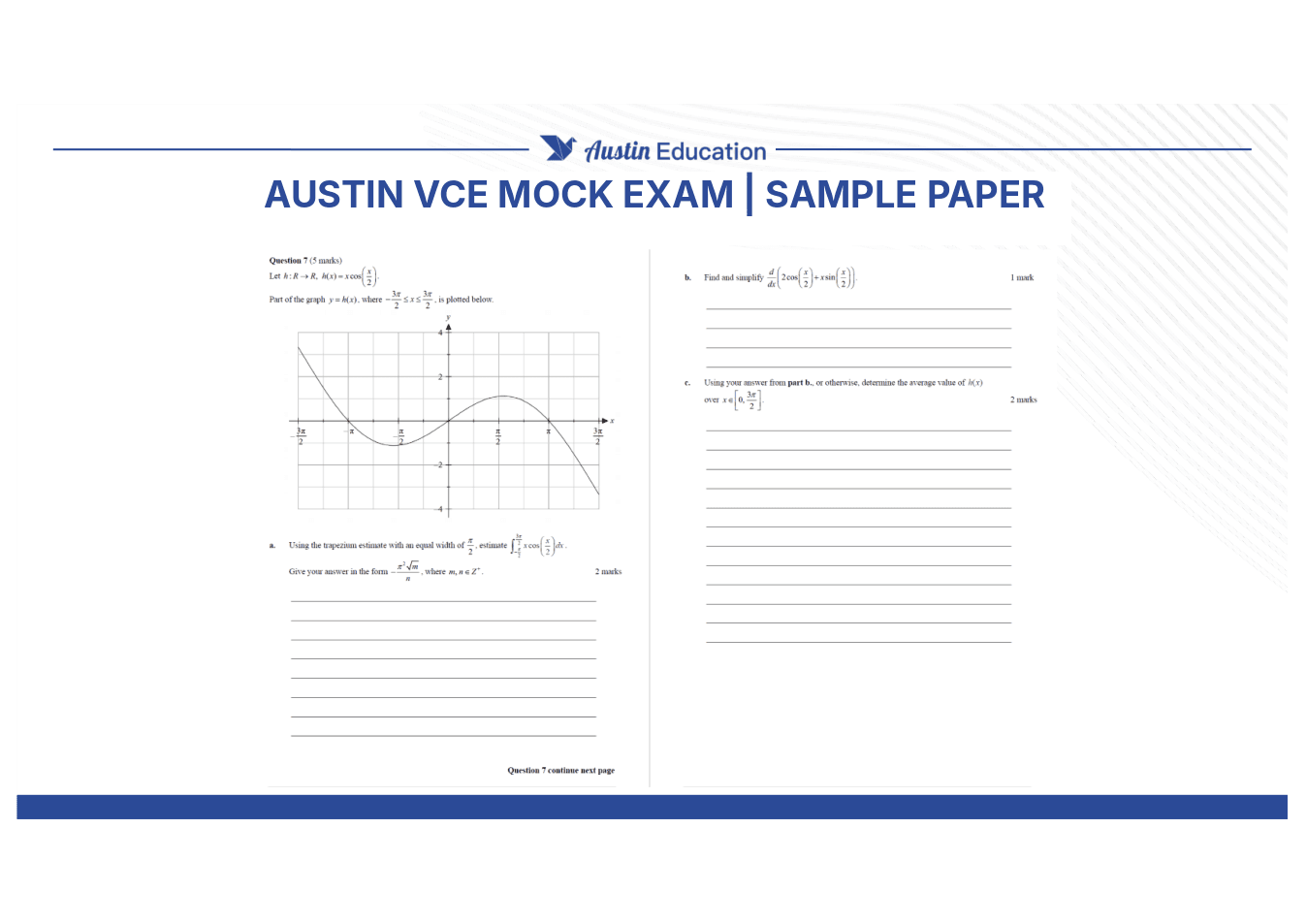
Original Mathematical Methods trial paper. VCE-style questions, diagrams and answer spaces designed for realistic timed practice.
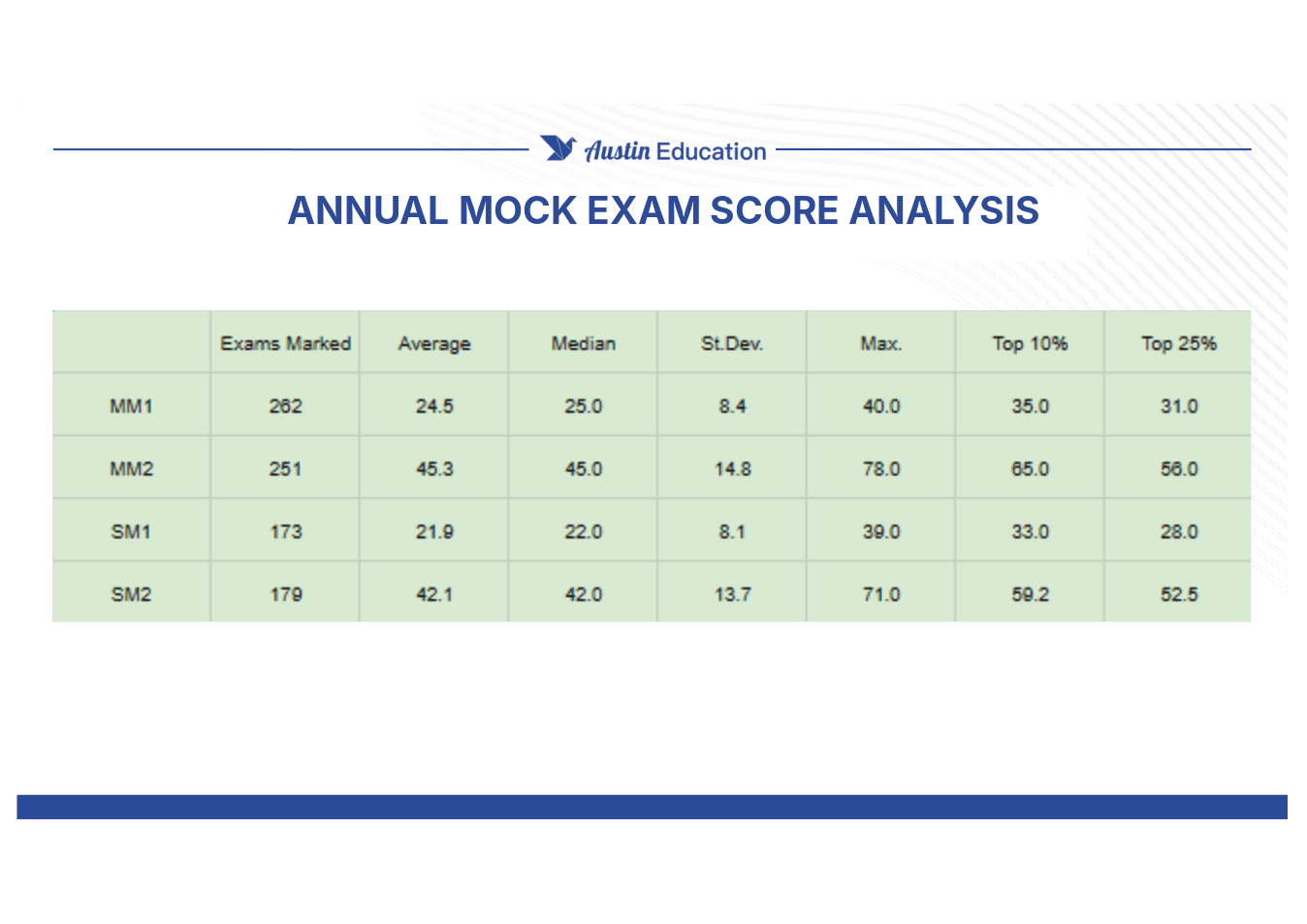
Anonymous mock exam performance analysis. Cohort averages, median scores, standard deviation and score bands help contextualise results.
Featured Past Exam Comparisons
See additional excerpts showing how Austin’s practice tasks developed concepts and writing themes tested in the final VCE exams.
2025 · English & EAL
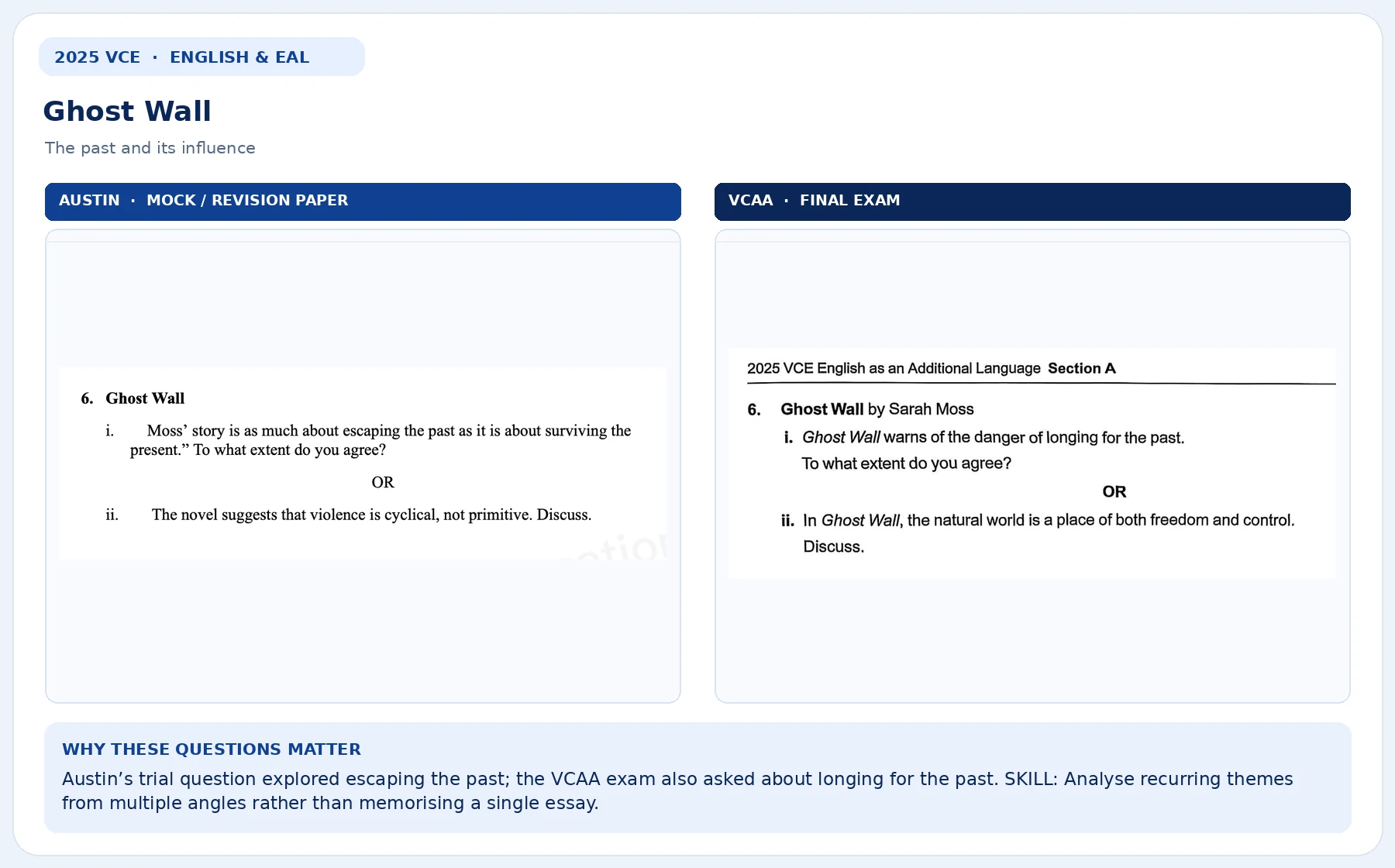
Ghost Wall
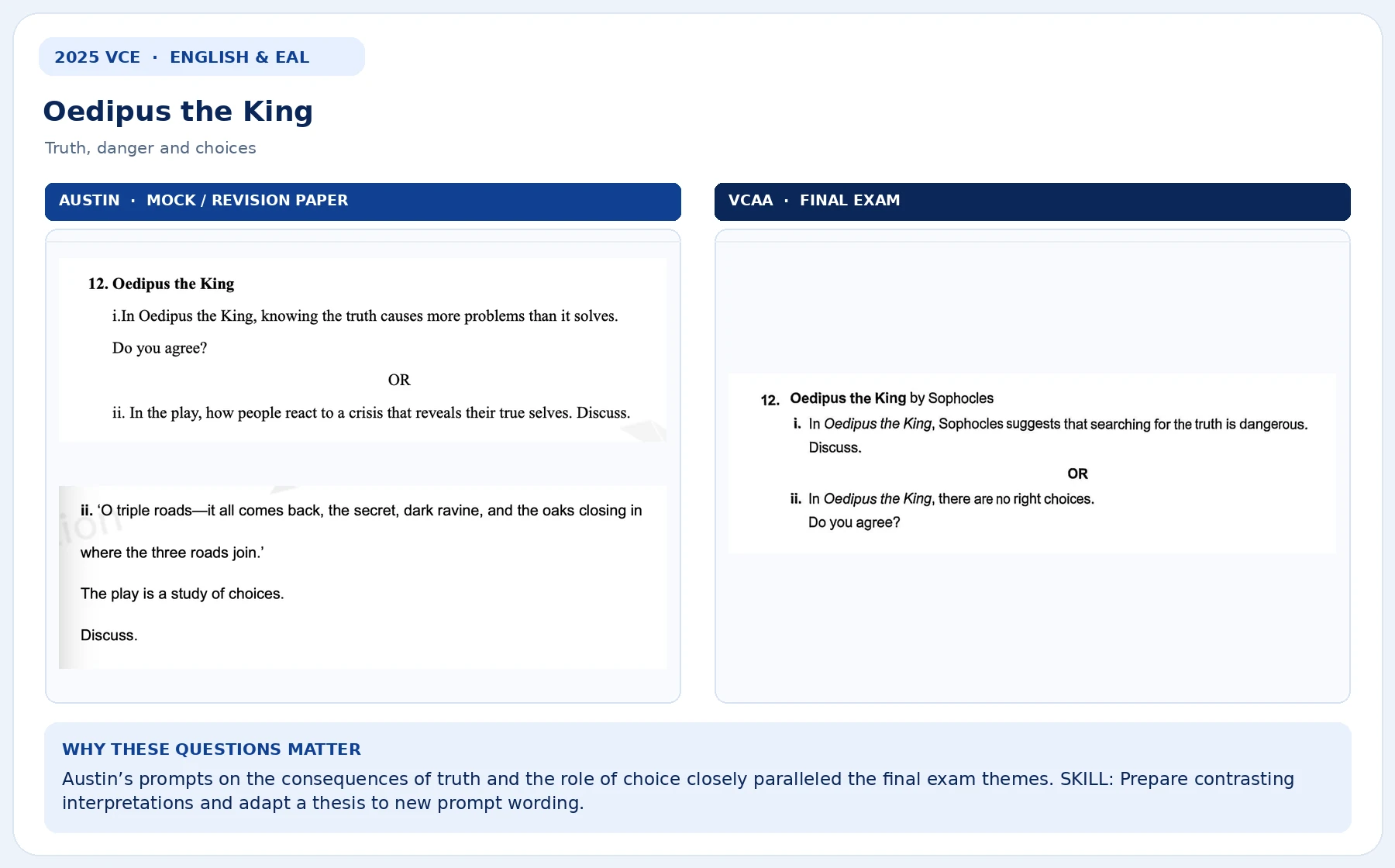
Shared exam focus: Austin’s trial question explored escaping the past; the VCAA exam also asked about longing for the past.
How this helps students: Analyse recurring themes from multiple angles rather than memorising a single essay.
Shared exam focus: An October Austin trial task used cubic modelling and simultaneous equations; the VCAA Exam 2 question drew on a related parameter-finding method.
How this helps students: Translate function conditions into equations and solve systematically.
Shared exam focus: Austin’s September trial used calculus and Pythagoras to find a minimum distance; the VCAA paper tested related vector-calculus distance reasoning.
How this helps students: Form an expression for distance and optimise it using calculus or an appropriate graph.
Searching for VCE mock exams near me? Enquire with Austin Education about trial exam sessions for Year 12 students at our Melbourne campuses. Subject availability, dates, venues and fees are confirmed when you book.
Every September, Austin Education hosts large-scale VCE Mock Exams during the Term 3 school holidays, giving students the opportunity to practise under exam conditions and prepare for their final VCE exams.
Contact our team to find out about upcoming mock exam dates, campus locations, available subjects, exam formats, fees, and marking and review options.
What should I look for in the best VCE mock exams in Melbourne?
Look for original questions written by experienced teachers and exam authors, alignment with the relevant VCAA Study Design, realistic time limits, clear marking criteria and useful teacher feedback. Austin Education brings these elements together with an exam-writing programme established in 2014.
Are Austin’s VCE mock exams written by VCAA examiners?
Austin’s academic team includes VCAA examiners and experienced VCE examination-paper writers. In Mathematics, the team includes official VCAA examiner Peideng Nie and long-standing exam-paper author John Kermond. Subject-specific questions are developed with close attention to VCAA requirements.
What is the difference between a VCE trial exam and a past exam paper?
A past VCAA paper shows what has already been assessed. Austin’s original trial exams provide new questions that practise the subject’s examinable skills, unfamiliar scenarios and time-management demands, followed by marking and review to identify where students can improve.
Have Austin mock exam topics appeared in the actual VCE exams?
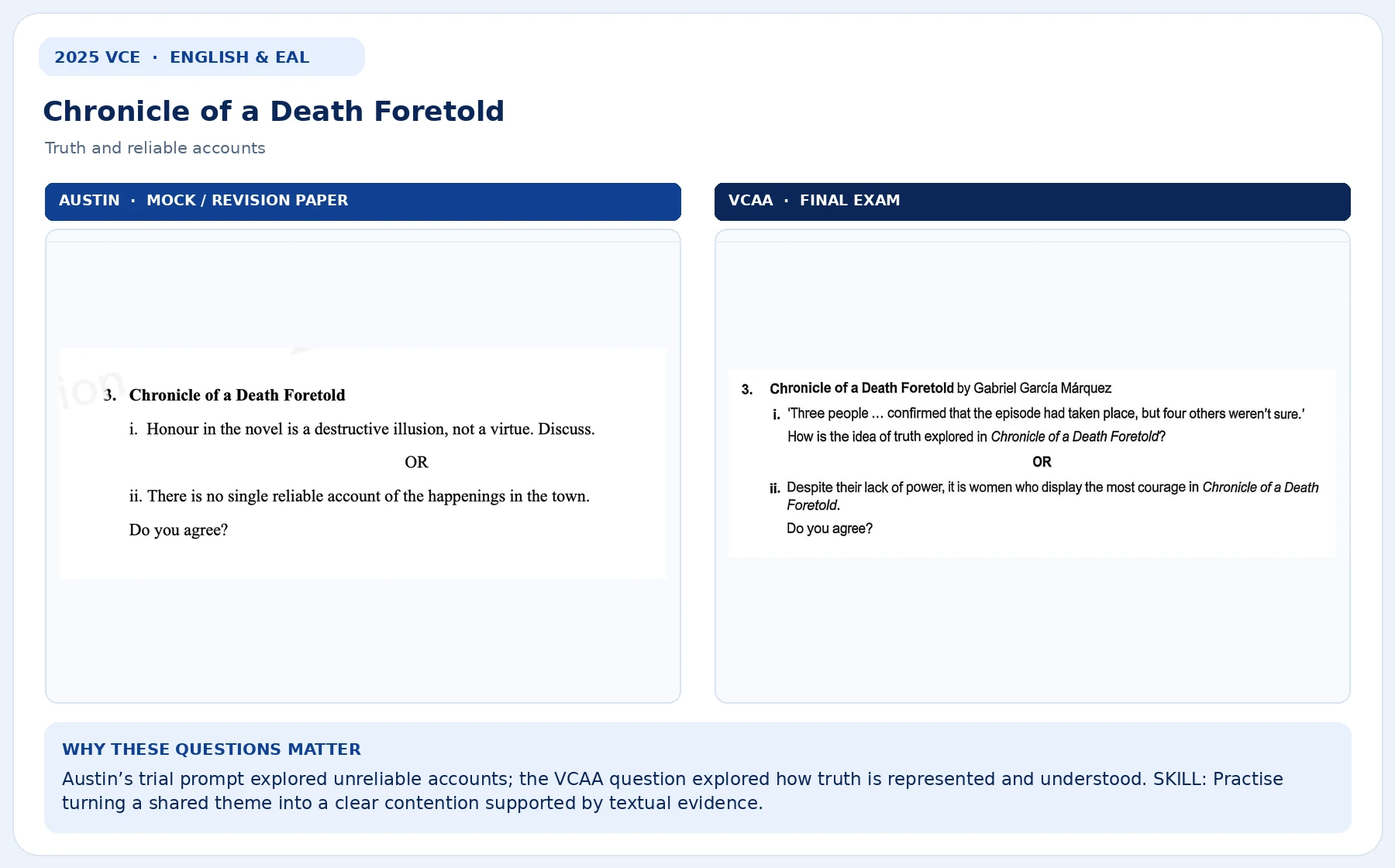
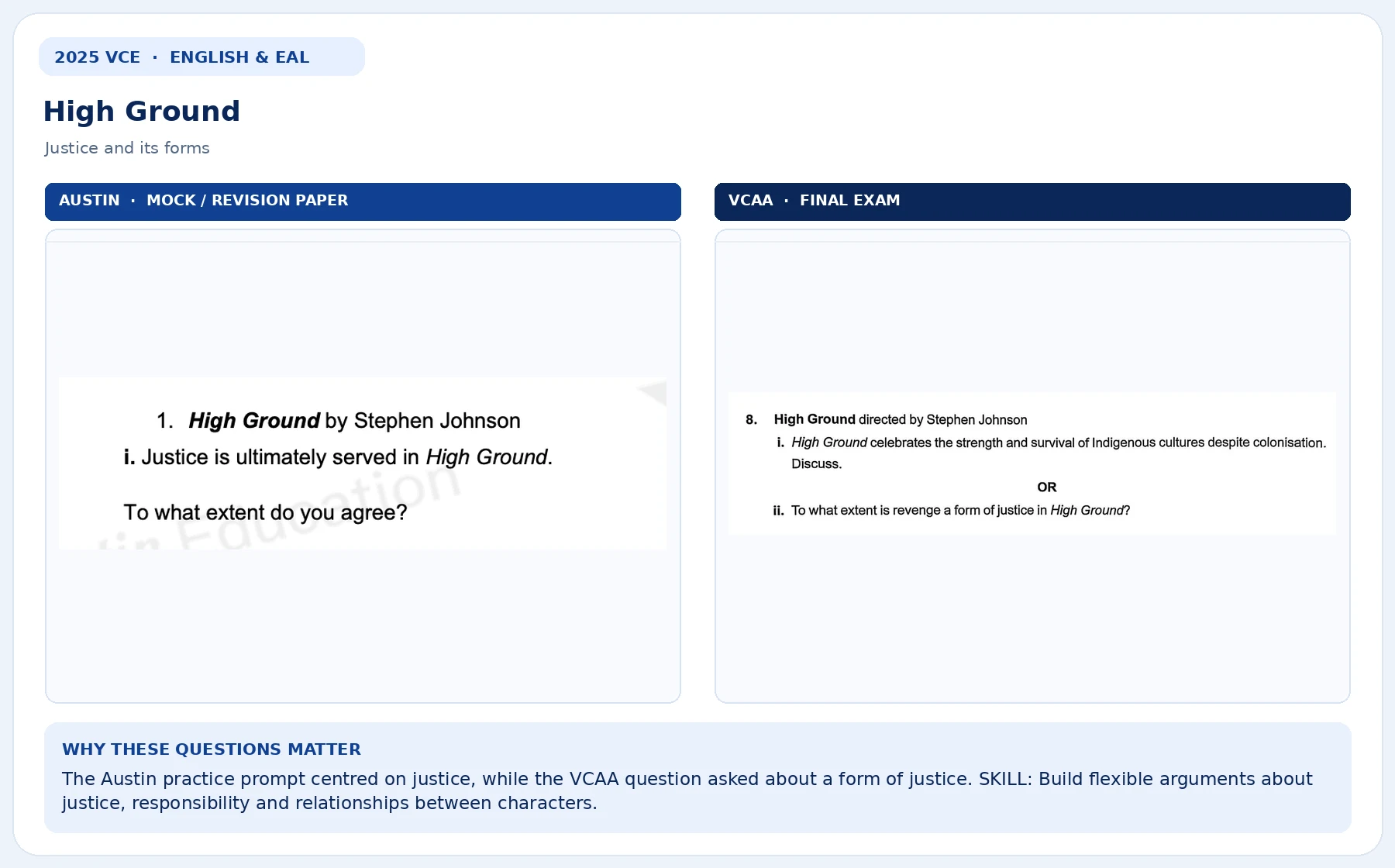
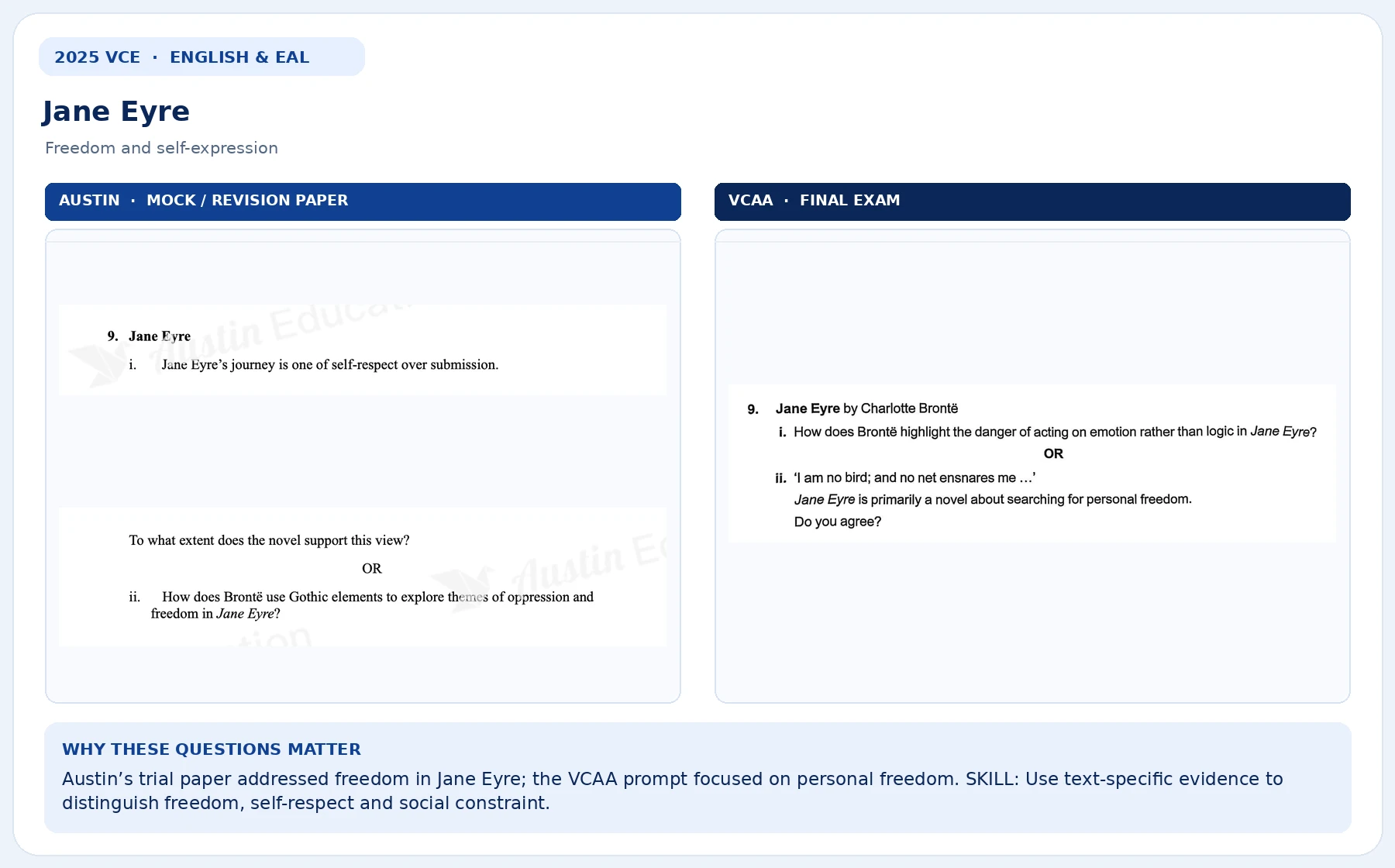
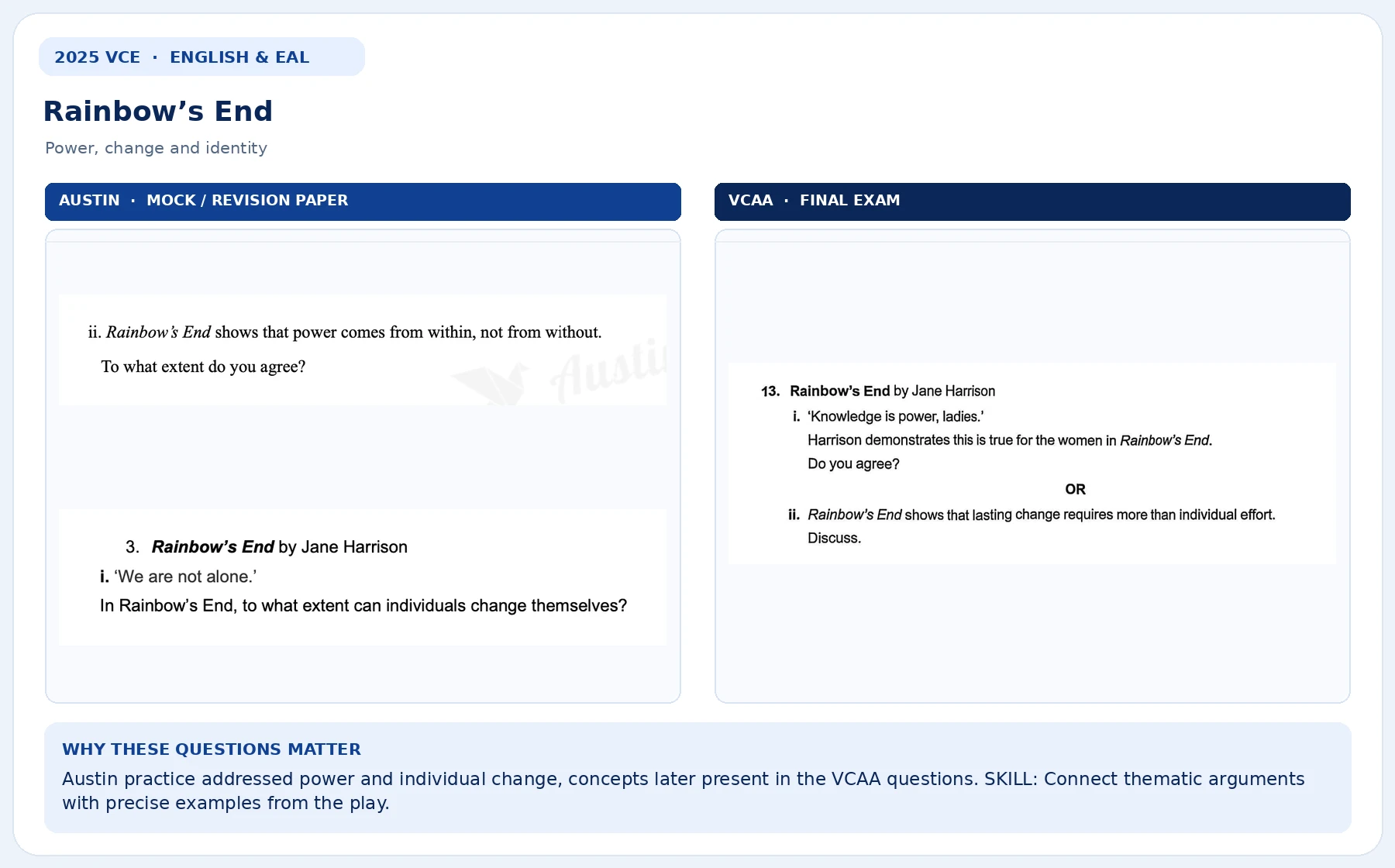
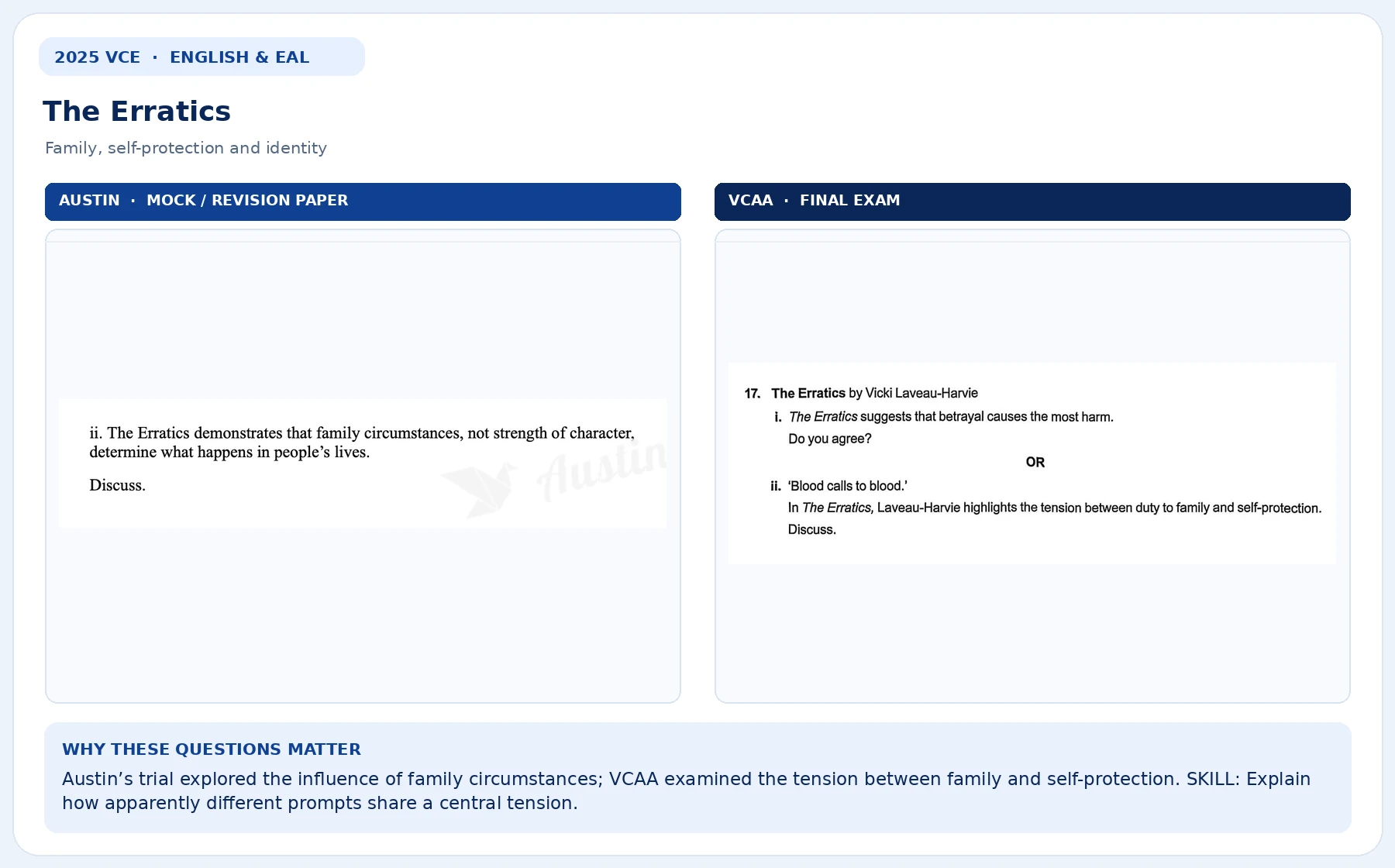
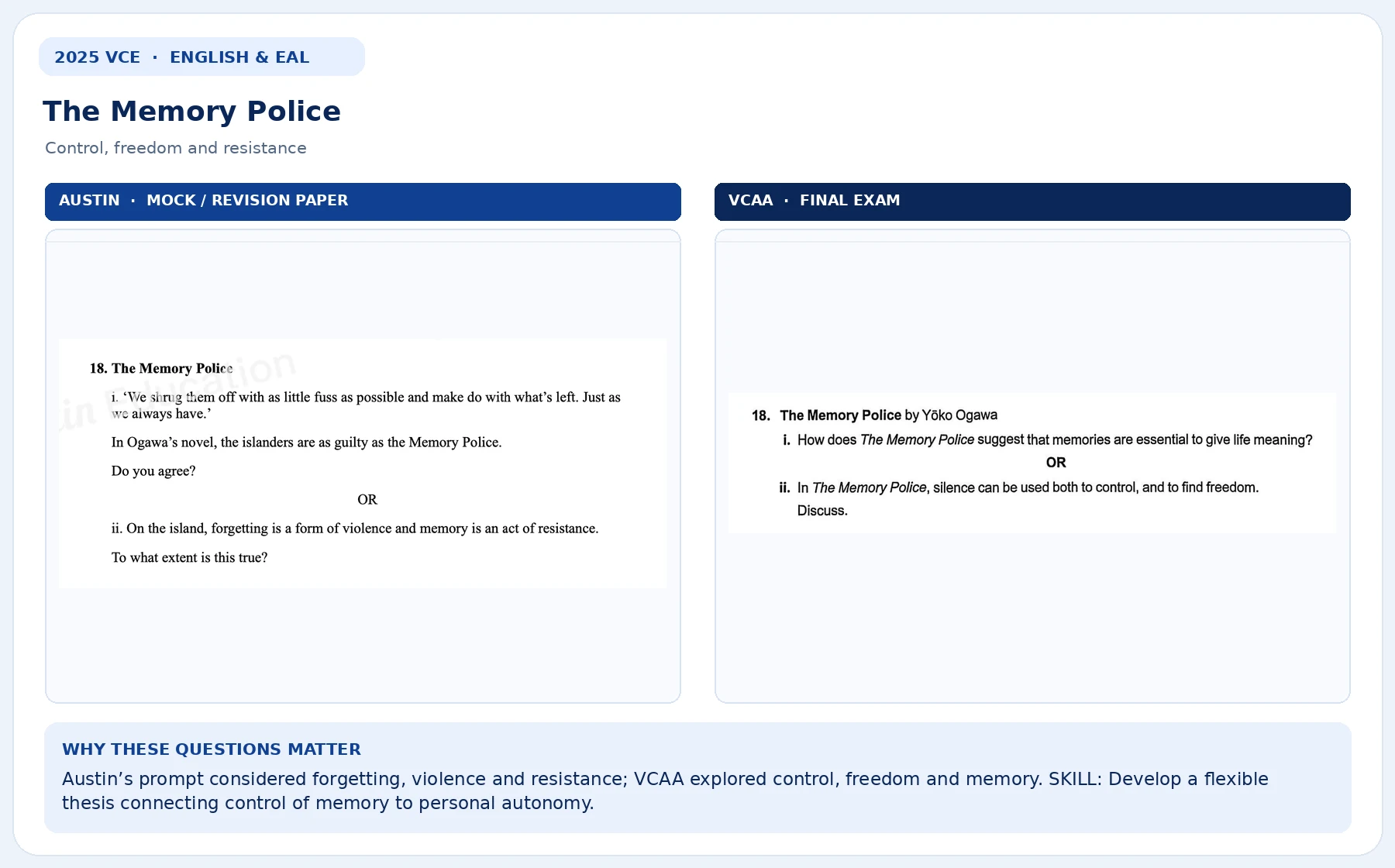
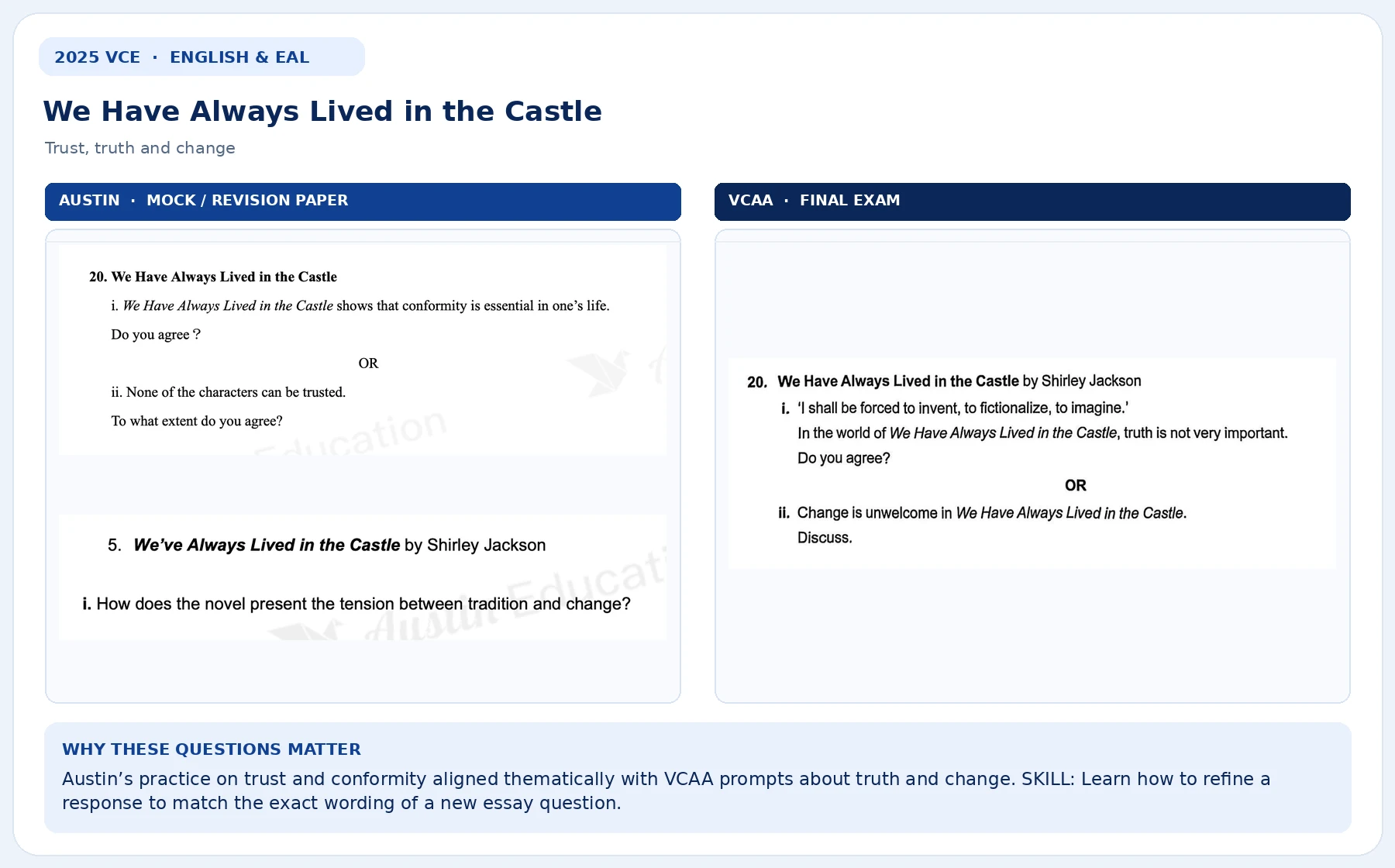
Yes. Our published comparisons show overlapping themes and skills between Austin practice papers and final VCAA examinations. Examples include 2025 English and EAL prompts on personal journeys, truth, freedom and power, plus 2024 Mathematical Methods and Specialist Mathematics questions involving function modelling, composite functions and vector reasoning. Browse the subject-filtered English, Chinese and Mathematics comparisons above to inspect the original excerpts.
Are Austin VCE mock exams more difficult than the real exam?
Austin includes challenging, higher-order questions to stretch capable students and improve their ability to handle unfamiliar problems. The goal is purposeful difficulty based on examinable knowledge and VCAA expectations—not unrelated or unnecessarily obscure questions.
Will a teacher mark my VCE mock exam and explain the answers?
Austin’s mock exam programme includes marking, review and feedback. Mathematics marking-guide examples break down the working, reasoning and marks awarded, while teachers explain answer structure and common errors. Check the inclusions for your chosen subject and sitting.
Which VCE subjects does Austin offer mock exams for?
The programme covers General Mathematics, Mathematical Methods, Specialist Mathematics, English, EAL, English Language, Chinese Second Language, Chinese Second Language Advanced, Chinese First Language, Biology, Chemistry, Physics, Psychology and Accounting. Ask about the next sitting for your subject.
Are VCE trial exams held under timed examination conditions?
Yes. Austin’s VCE trial exams are designed for timed practice. The exam duration, permitted materials and paper structure depend on the subject and the specific sitting, helping students rehearse realistic exam conditions.
What happens after my VCE mock exam results are released?
Review your marked work to find lost marks, knowledge gaps, answer-writing issues and timing problems. Teacher explanations and targeted follow-up practice help turn the result into an action plan for the remaining VCE exam preparation.
When did Austin Education start running VCE mock exams?
Austin launched its VCE Mathematics mock exam programme in Melbourne in 2014 and expanded to subjects including English, Science, Chinese and Accounting in 2017. That history of examination writing and reviewing continues to inform the papers offered today.
Where can I book a VCE mock exam in Melbourne?
Contact Austin Education to enquire about VCE trial exams at Box Hill, Melbourne CBD, Mount Waverley and Ormond. The team can confirm the next date, subject, campus, fees and marking or review arrangements before you register.
Prepare for VCE Exams with More Than Another Practice Paper.
Experienced exam authors. Challenging VCAA-aligned questions. Teacher marking and practical feedback on how to earn marks.