

How to Become a Doctor in Australia: A Melbourne Student's Pathway Guide
A clear, reality-based guide to VCE planning, UCAT ANZ, interviews, undergraduate and graduate-entry medicine — and what happens after medical school.
- 12 min read
- Melbourne, VIC
- Years 7–12 · Students & Parents
Quick Answer
What is the best pathway to medicine for a Melbourne student?
There is no single "best" route. School-leaver medicine can require strong Year 12 results, course-specific prerequisites, UCAT ANZ and an MMI. Graduate-entry medicine comes after a bachelor degree and commonly considers GPA, GAMSAT and interview performance. The practical first step is to identify your target universities, read their current requirements, then build a sustainable academic plan — not chase one number or one course title.
Key Takeaways
- 1Start with the route, not the rumour. Direct-entry and graduate-entry medicine select differently; published requirements can change by intake.
- 2UCAT is one component, not the whole application. Its use, weighting and interview thresholds are set by each university.
- 3Choose VCE subjects from verified prerequisites. For Monash domestic direct entry, the published VCE prerequisites include English and Chemistry; Biology is not compulsory.
- 4A bachelor degree is not a "failed plan". It can be a deliberate graduate-entry route if chosen for fit, academic strength and real career value.
- 5Medical school is not the finish line. Internship, registration and specialist training are distinct stages of a longer professional journey.
Medicine Pathways Australia
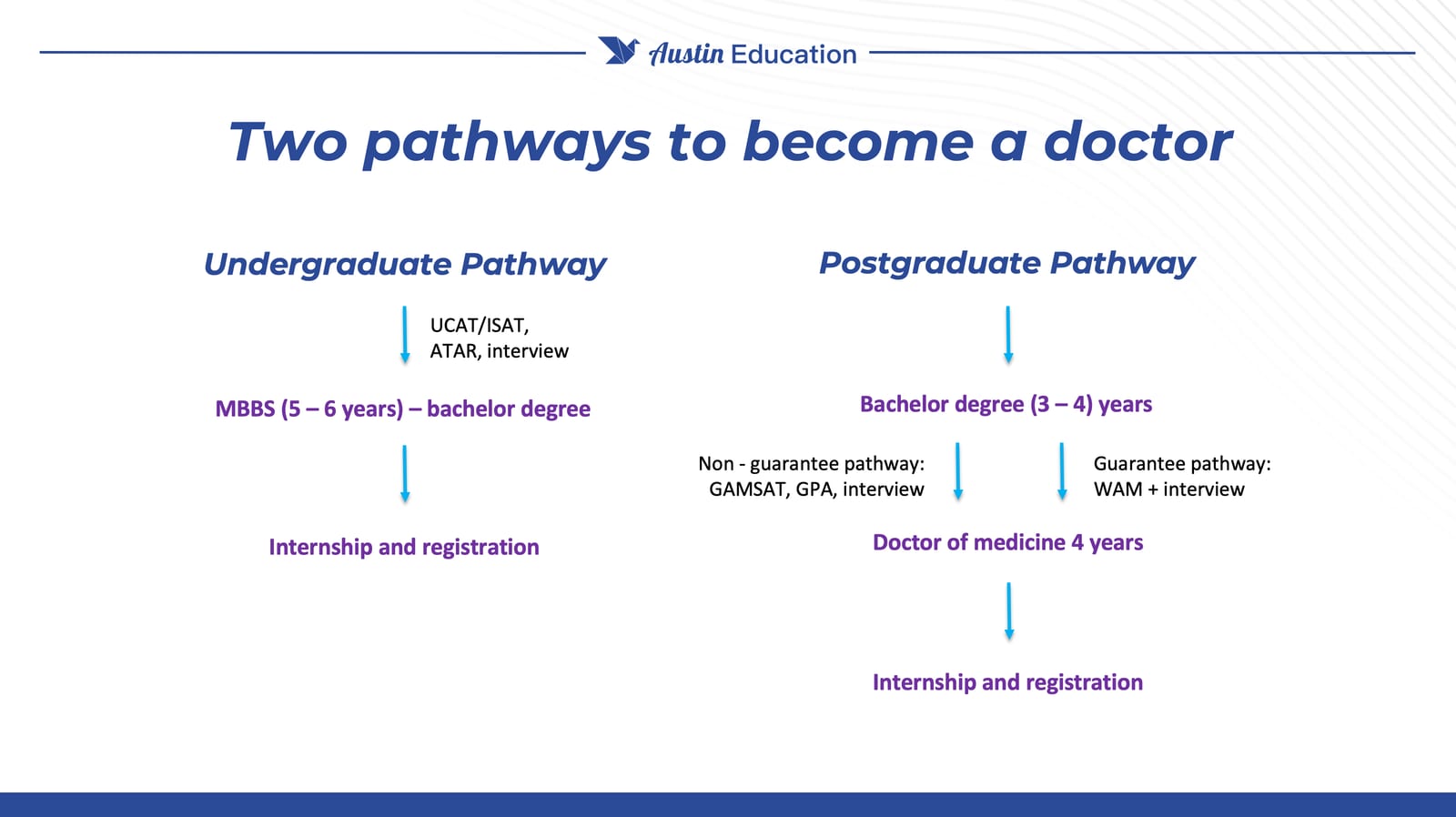
Two Main Ways to Enter Medical School in Australia
The medicine pathway begins with an admissions model, not a fixed checklist. The exact combination of academic results, tests, prerequisites and interview differs across institutions. For Melbourne families, it is useful to understand the two broad models first.
School-Leaver / Direct Entry Medicine
Apply after Year 12 for an integrated undergraduate medical degree. A Victorian example is Monash's direct-entry Bachelor of Medical Science and Doctor of Medicine.
- Year 12 results and course prerequisites
- UCAT ANZ where the university requires it
- MMI or another interview process
Graduate-Entry Doctor of Medicine
Complete a bachelor degree first, then apply for a graduate medical degree. At the University of Melbourne, the standard MD pathway accepts a bachelor degree in any discipline.
- Academic performance, normally expressed as GPA
- GAMSAT for the standard domestic pathway
- MMI and pathway-specific eligibility rules
A key planning principle: choose a degree you can genuinely do well in.
The University of Melbourne's standard MD pathway states that a bachelor degree may be in any discipline. "Biomedical" in the degree title is not a universal shortcut. Academic performance, eligibility and a viable alternative career pathway matter.
 Click to view full size
A Melbourne Example · Always Check the Current Intake
What Does Direct-Entry Medicine Look Like? Monash as a Current Example
For domestic applicants to Monash Direct Entry Medicine, the current published minimum eligibility includes an ATAR of 90, VCE English and Chemistry prerequisites, UCAT ANZ, and an MMI. A minimum is not a competitiveness guarantee: Monash explicitly notes that final ATARs are usually significantly higher because places are limited and applicants are numerous.
Prerequisites are course-specific
Do not assume a subject is compulsory nationally. For the current Monash domestic pathway, VCE English and Chemistry are published prerequisites; Year 12 Biology is not required, though admitted students without Biology are advised to take a bridging course.
Communication is assessed directly
Monash's published MMI uses six sequential stations focused on advocacy, collaboration, critical thinking, empathy, ethical reasoning, motivation and resilience. This is why thoughtful communication practice belongs in a medicine plan.
Use historical cut-offs as context — not a target that guarantees anything.
Monash publishes historic UCAT interview information and states that cut-offs can change each year with the number of interview places and the score distribution of eligible applicants. Build depth across academics, UCAT and interview rather than relying on one prediction.
UCAT ANZ Explained
UCAT ANZ: An Admissions Test, Not a Measure of “How Smart You Are”
UCAT ANZ is used by consortium universities for relevant medicine, dentistry and clinical-science programs, alongside academic qualifications and interviews. It is computer-based and universities — not the test provider — decide how scores are used in selection.
300–900 scaled
300–900 scaled
300–900 scaled
separate 300–900 score
Official scoring note: the three cognitive scores are summed to a 900–2700 total. Situational Judgement is reported separately. There is no negative marking, and the test is not adaptive. For a full breakdown, read our guide to how UCAT scoring works.
UCAT Preparation Melbourne
Prepare Strategically: Build Familiarity Before You Build Volume
A recurring concern in VCE student discussions is how to fit UCAT preparation around school demands without buying every resource or burning out. The official UCAT ANZ advice is the logical starting point: use its free preparation plan, Tour Tutorial, question tutorials, question banks and representative timed practice tests. Then make any additional support purposeful.
Unstructured preparation
- Collect every platform before understanding the test.
- Treat every wrong answer as the same problem.
- Let practice displace VCE foundations.
Deliberate preparation
- Learn format and tools from official materials first.
- Track accuracy, timing and decision-making patterns.
- Schedule timed work around — not instead of — academic priorities.
Graduate Entry Medicine
University of Melbourne MD: Why "Guaranteed Entry" Is Not a Safe Shortcut to Repeat
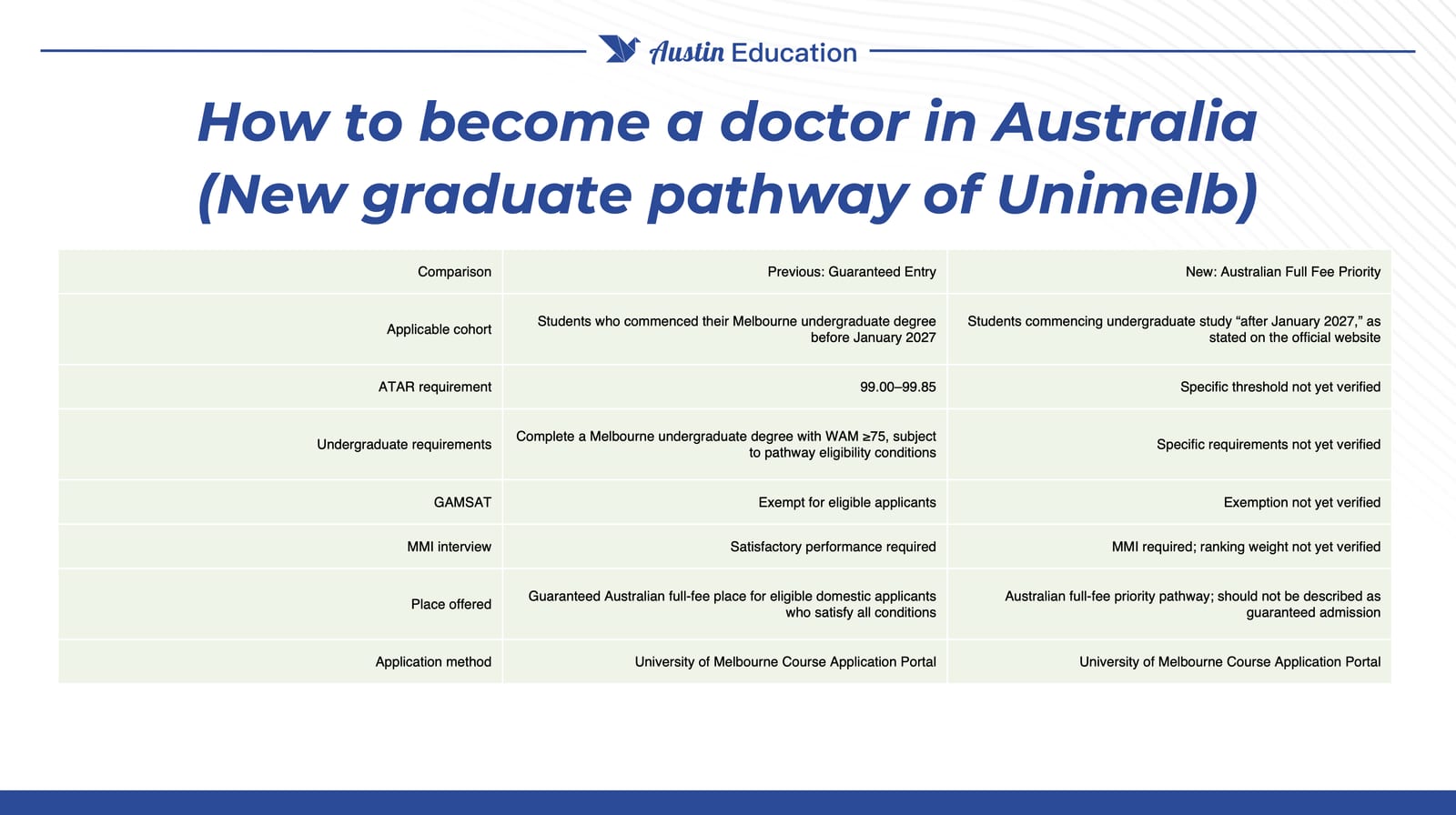
For the University of Melbourne's standard domestic MD pathway, the published 2027-entry criteria include an eligible bachelor degree, GAMSAT with a minimum 50 in each section, and satisfactory MMI performance. The final ranking after interview is published as 50% interview, 25% GPA and 25% GAMSAT.
The University also states that students who commence undergraduate study after January 2027 may access an Australian Full Fee Priority pathway if eligible. Its name matters: it is a priority pathway, not a blanket promise of MD admission. Read the current course page before making long-term decisions.
A cost conversation belongs in the plan.
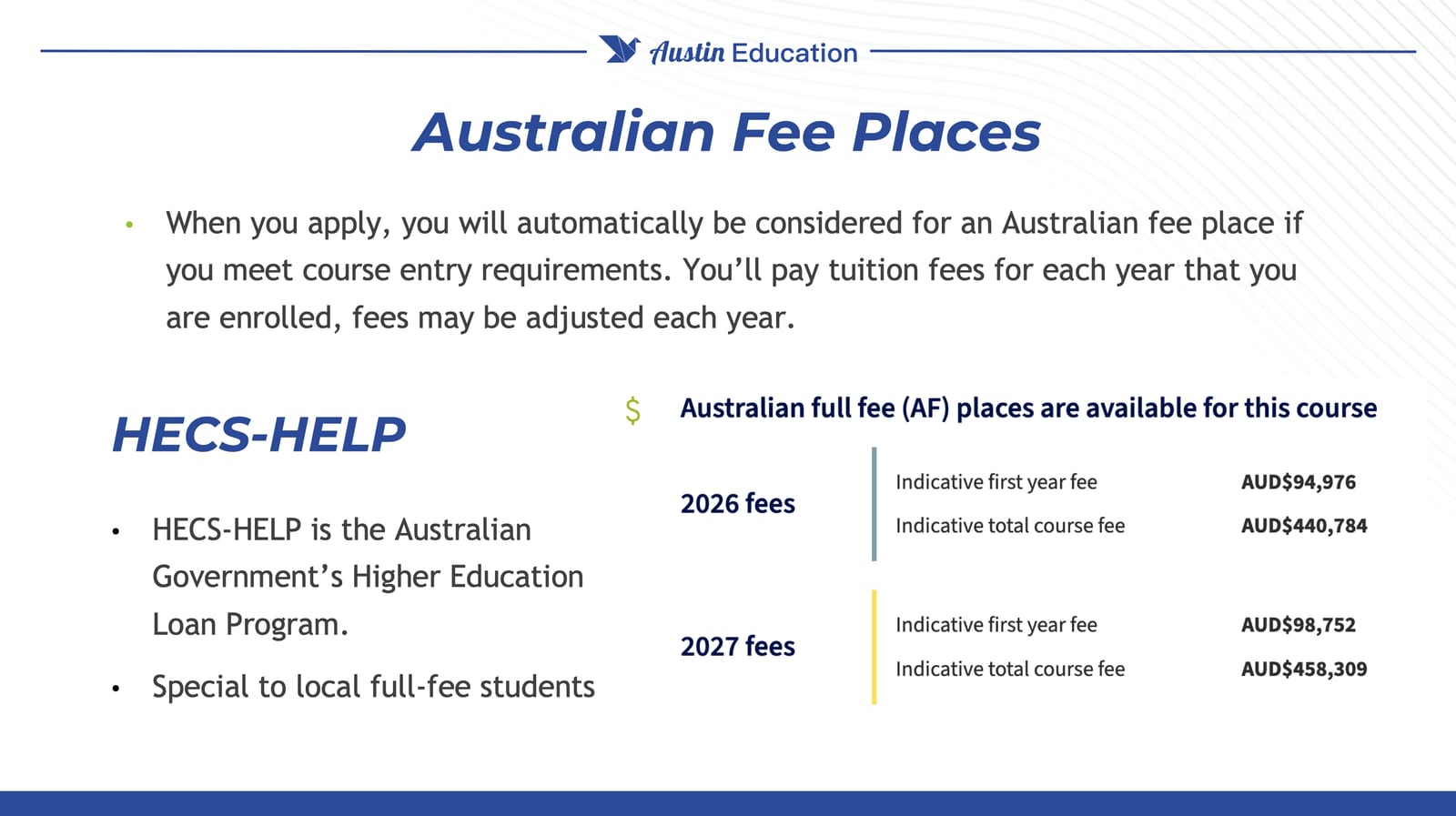
The University of Melbourne lists both CSP and Australian full-fee places for the MD. Its 2027 indicative Australian full-fee total is AUD $458,309, subject to annual review. A CSP is government-subsidised, while eligible students may use relevant HELP loans under current rules. Families should check the fee page and independent financial advice before committing.
 Click to view full size
 Click to view full size
VCE Medicine Pathway
What Should a Future Medical Student Focus on at School?
The lecture behind this guide makes an important point: academic strength has to be built progressively, not improvised in Year 12. That does not mean every student should accelerate or follow the identical subject mix. It means goals should match readiness, wellbeing and verified prerequisites.
Build literacy & numeracy
Strengthen reading accuracy, problem-solving, curiosity and study habits. These are foundations for later VCE, UCAT and communication — not a reason to rush specialised test training.
Explore with evidence
Check subject prerequisites, experience science content honestly, and discuss whether acceleration suits your broader learning plan.
Protect the academic core
Complete requirements for realistic target courses; pursue sustained VCE performance; add UCAT work according to the official cycle and personal timetable.
Develop communication
Writing, listening, ethical thinking, collaboration and clear speech matter in interviews and in healthcare itself.
After Medical School
Medical School Is a Milestone — Not Automatic General Registration
After graduation, Australian and New Zealand medical graduates ordinarily undertake an accredited internship under provisional registration. The Medical Board of Australia explains that graduates who meet postgraduate year one requirements can apply for general registration; the employer confirms completion requirements directly with Ahpra. Specialty training then has its own selection and training processes.
Medicine is a long professional pathway
A thoughtful plan includes interest in patient care, resilience, communication and a sustainable reason to pursue the work — not only a course offer.
Keep the field broader than one title
Dentistry, optometry, pharmacy, physiotherapy, nursing, radiography and many other careers serve patients in different ways. Research each profession's accredited study and registration pathway directly.
Frequently Asked Questions
Medicine Pathways Australia: Melbourne Student FAQs
What is the main pathway to become a doctor in Australia after Year 12?
School-leaver medicine is one route: universities may use Year 12 results, prerequisites, UCAT ANZ and interviews. Graduate-entry medicine is another: first complete a bachelor degree, then meet the university's current GPA, GAMSAT and interview requirements.
Can I study medicine after a non-biomedical bachelor degree?
Yes. The University of Melbourne's standard MD pathway accepts an eligible bachelor degree in any discipline. Course choices should be based on fit, the capacity to achieve strongly and genuine alternative career value — not an assumption that one degree title is automatically preferred.
Does every medicine pathway require UCAT ANZ?
No. UCAT ANZ is used by relevant consortium universities for certain undergraduate programs. Other pathways may not require it, while graduate-entry medicine may use GAMSAT. Verify the relevant university requirements for your intake year.
Is Biology compulsory for medicine in Victoria?
It varies. Monash's currently published domestic direct-entry prerequisites are English and Chemistry; Biology is not required. Because course rules vary and change, check the current page for each target course before finalising VCE selections.
When should I begin UCAT preparation?
Begin with the official test cycle for your intended entry year. Familiarise yourself with the test format and official free resources, then plan timed practice around school commitments. Avoid sacrificing VCE foundations for an unstructured workload.
What happens after medical school?
Medical graduates ordinarily complete an accredited internship while provisionally registered, then apply for general registration once Medical Board requirements are met. Specialty training comes later and has its own selection processes.
Does Austin Education guarantee entry into medicine or a UCAT score?
No. Austin Education provides academic and UCAT preparation support; university admissions decisions, test outcomes and professional registration are controlled by the relevant universities, testing bodies and regulators.
Build a Medicine Plan That Starts With the Right Questions.
From VCE science foundations to UCAT strategy, Austin Education can help Melbourne students turn a broad ambition into a structured academic plan. Start with a conversation about your current year level, subjects, goals and realistic next step.
Book a Consultation →- ✓Requirements vary by university
- ✓UCAT is not every pathway
- ✓Minimum ≠ competitive
- ✓Medicine is a long-term profession
Related Articles
Sources checked 9 October 2026: Monash University Direct Entry Medicine domestic entry requirements; University of Melbourne Doctor of Medicine entry requirements, application and fees pages; UCAT ANZ official scoring, preparation resources and test information; Medical Board of Australia provisional-to-general registration guidance. Austin statements are sourced from the 2026 Medicine Information Session. This page is general educational information only; requirements, fees, dates and selection procedures may change. Verify every decision with the relevant university, test provider and regulator.
By Austin Education UCAT Team
Published